Sabah, Malaysia August 3 – September 19, 2025 Callyn Yorke
Introduction
Compared with cosmopolitan Peninsular Malaysia, much of Sabah today is rural and retains the traditional Malay lifestyles reminiscent of Peace Corps days. At the time I was stationed in Kuala Lumpur for three years, teaching zoology at the National University (UKM, 1977-80). Coursework included opportunities for field trips in Peninsular Malaysia, e.g. Port Dickson, Fraiser’s Hill, Pasoh Forest Reserve,Taman Negara and Trengganu. All the while I kept an exploratory eye on a map of greater Malaysia.
Sabah and Sarawak had been on the radar though rather far fetched for a UKM class field trip. The reality was that students felt going anywhere away from their village or hometown was more stressful than it was interesting or exciting. Field trips with these decidedly provincial folks required from me a considerable dose of cultural sensitivity. For example, many of them traveled with their own food, for fear of being poisoned by strangers. And when deep into a Malaysian rainforest, if a leech appeared on a female student, a chorus of screams broke out that could empty a football stadium.
Most of the students came from small villages (kampong Melayu) on the Peninsula. These were the sorts of places where turn signals were unnecessary because everyone knew where you were going, why you were going there and when you were leaving. The transition from rural life to city life must have been shocking for many of the UKM students. They meekly revealed that prior to relocating to KL, traveling far from their kampong was a rare event. It would have been surprising if any of them had been to the eastern Malaysian states of Sabah and Sarawak.
Aside from my concerns and those of a usually supportive UKM administration, I’m fairly certain the students would have survived a field trip to Borneo. They might have even been comforted by the familiar Malay attributes of Sabah, with notable differences in dialect and food. The biggest treat for all of us would likely have been the Bornean superstars, such as the Orangutan and Proboscis Monkey.
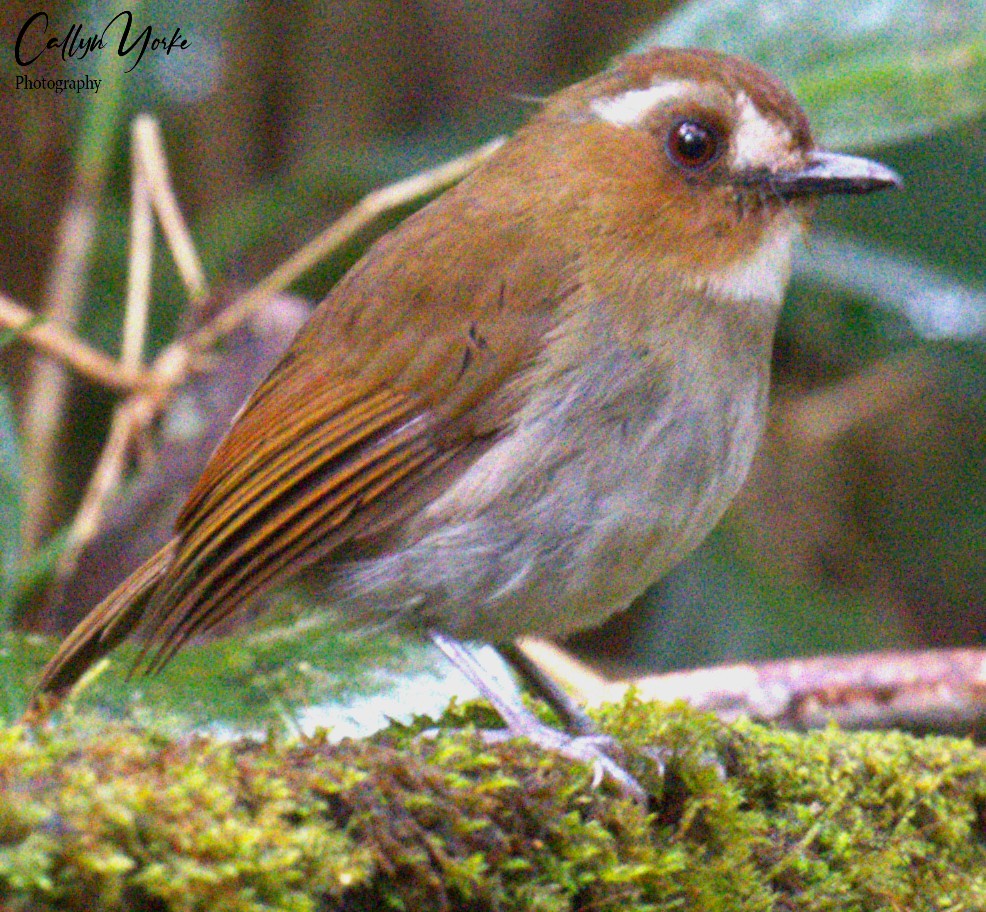
It became clear that to see the eastern Malaysian states in all their zoological splendor, the journey would have to be made on my own. In January of 1980, prior to my final semester at UKM, I visited Sabah for the first time. Coincidentally, two Peace Corps colleagues had transferred to the UKM Kota Kinabalu campus. One of them, Robert Curry, a mathematician from MIT, had taken up birding. Bob introduced me to the local avifauna that included widespread Asian species and notably, endemic subspecies with distinctive plumages and vocal repertoires.
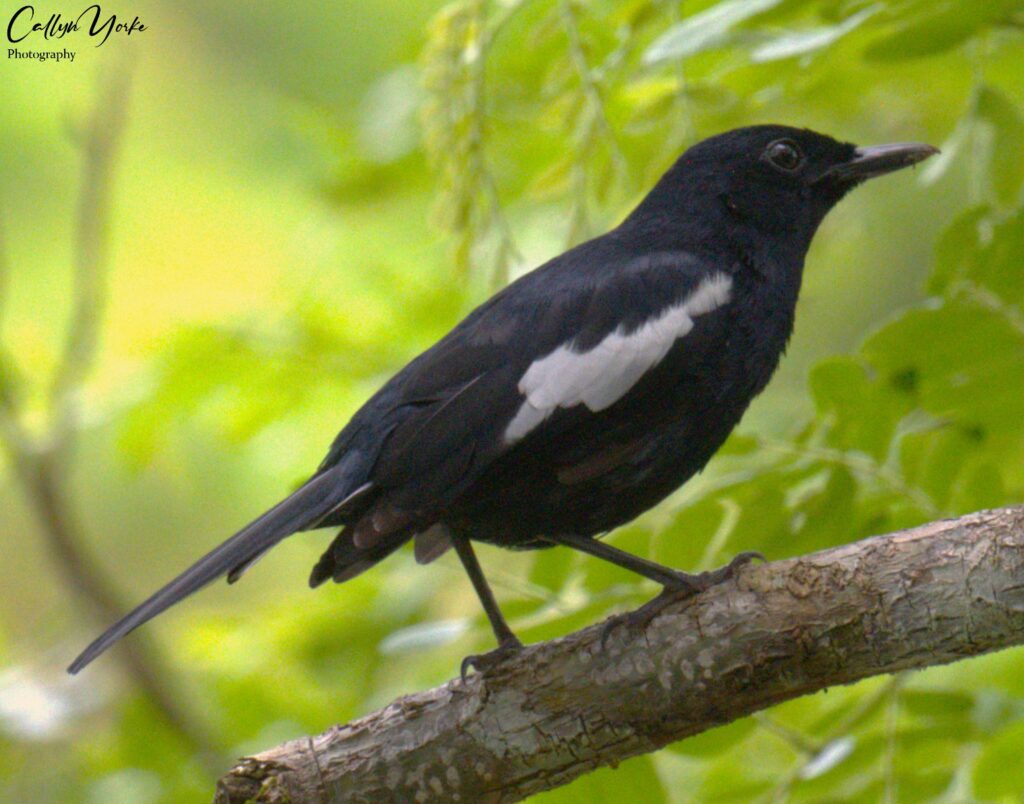
In those days there was precious little reference material for learning field marks of the birds found in Sumatra and Borneo. The first edition of Ben King’s Guide to the Birds of Southeast Asia (1975) provided excellent coverage for Peninsular Malaysia but was understandably deficient in Borneo where endemism is prolific. Bob was quick to point out that subspecies were absent from the numerically systematic list in the King guidebook and suggested they be assigned as a decimal addition in the page margins, e.g. #879.1 Sabah Magpie Robin (Copsychus saularis adamsi).
Beyond the capital city of Kota Kinabalu and its rural surroundings, several areas had high concentrations of endemic species. One historic location was Mt. Kinabalu National Park.
Near the end of the 1980 excursion in Sabah, three other mountaineers and I made a predawn, rope-assisted ascent to the windswept summit of Mt. Kinabalu. That climb was more of an endurance test than a natural history tour. Endemic birds and other wildlife occurred mainly on the leisurely lower slopes, i.e., between 1,200 m and 1,800 m.
In view of the park’s current popularity, we were fortunate to have had a comparatively solitary experience on the jagged peak, which at 4,095 m, is the highest mountain in Southeast Asia. Every facility of Mt. Kinabalu National Park is now geared for recreational tourism. Each morning, pedestrians on the main thoroughfare step aside for the parades of minivans packed with climbers. The park service issues a health safety advisory – one step short of requiring medical clearance.The trek to the summit is rigorous and unforgiving.
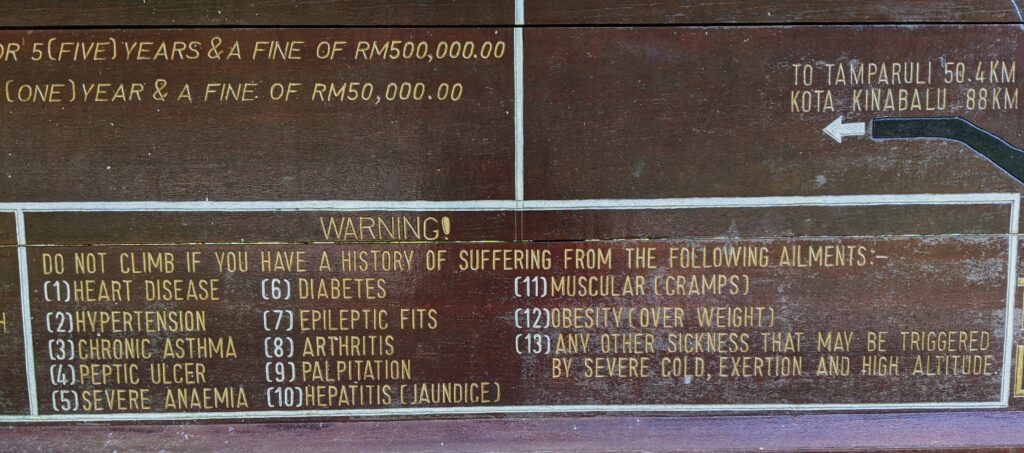
For the lone traveler the combined cost for food, lodging, guides, permits and transportation from Kota Kinabalu, could easily reach $500 USD per day (1 USD = 4.28 MYR). Lodging in Mt. Kinabalu National Park is usually fully booked several months in advance. The park has become quite the social scene for affluent tourists. Budget travelers, e.g. the younger generation of birders and naturalists, may find affordable homestay accommodations outside the park, though decent lodging is difficult to obtain without advance reservations.
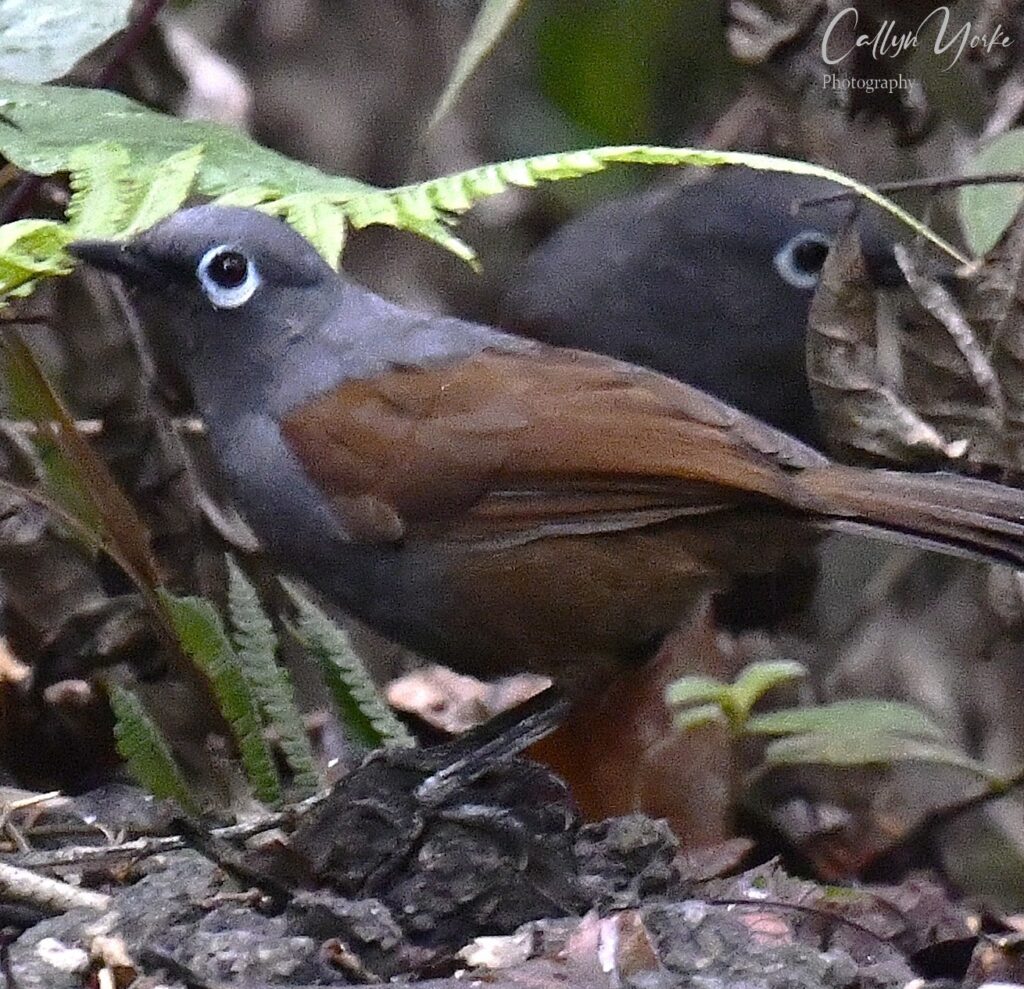
Poring Hot Springs is now part of Mt. Kinabalu National Park and has also undergone a major commercial transformation. During a visit in 1980, it had sunken concrete boxes with ingenious plumbing built by Japanese occupiers during WW II. All of that is now gone, along with the historical context. Back then it was possible to soak in the warmth of the blended hot/cold spring water, in full view of butterflies, hornbills and barbets in the surrounding rainforest. With time, this hidden paradise would be discovered and modernized almost beyond recognition.
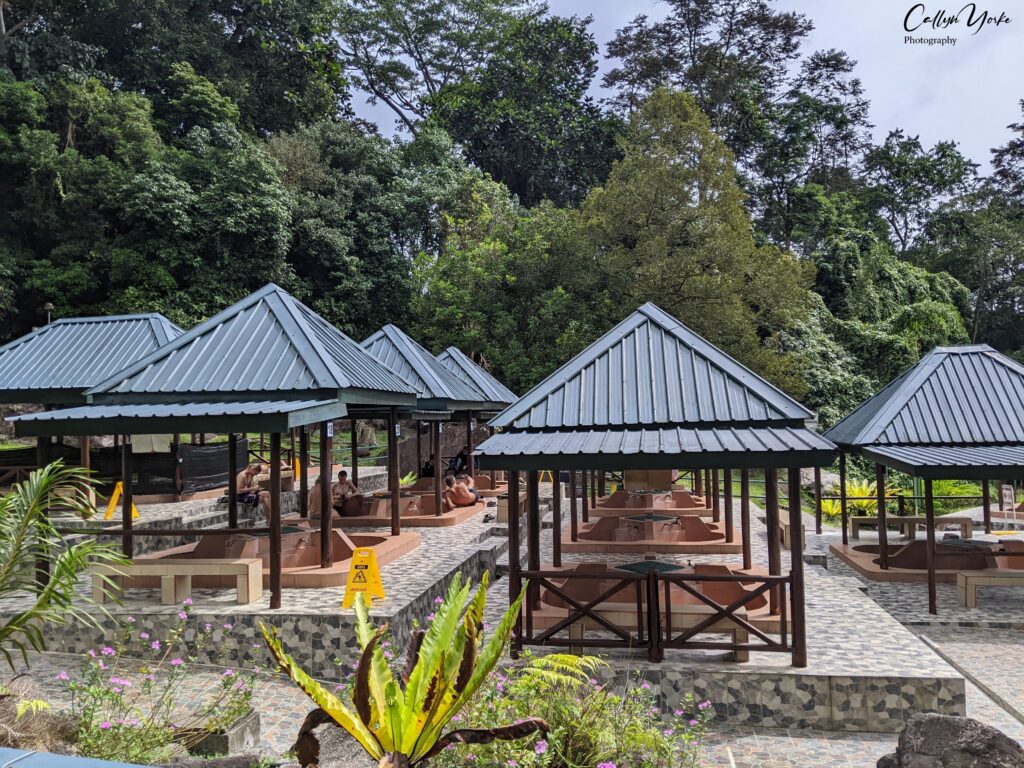
On Saturday morning, August 16, 2025, another birder and I visited Poring Hot Springs. We were a little late for optimal birding. The parking area was nearly full and so was a public swimming pool. What once was a secluded, post-war relic, had become a popular community playground. Paved walkways and fiberglass tubs shaded by stylish gazebos lined the hot springs basin. A new bridge over the central stream provided a setting for selfies. Trash cans dotted the trail leading to the canopy walkway (currently closed for maintenance), along with signs reminding visitors to respect the natural resources. Much to my surprise the dipterocarp rainforest was intact and had not been converted to another one of the ubiquitous oil palm plantations.
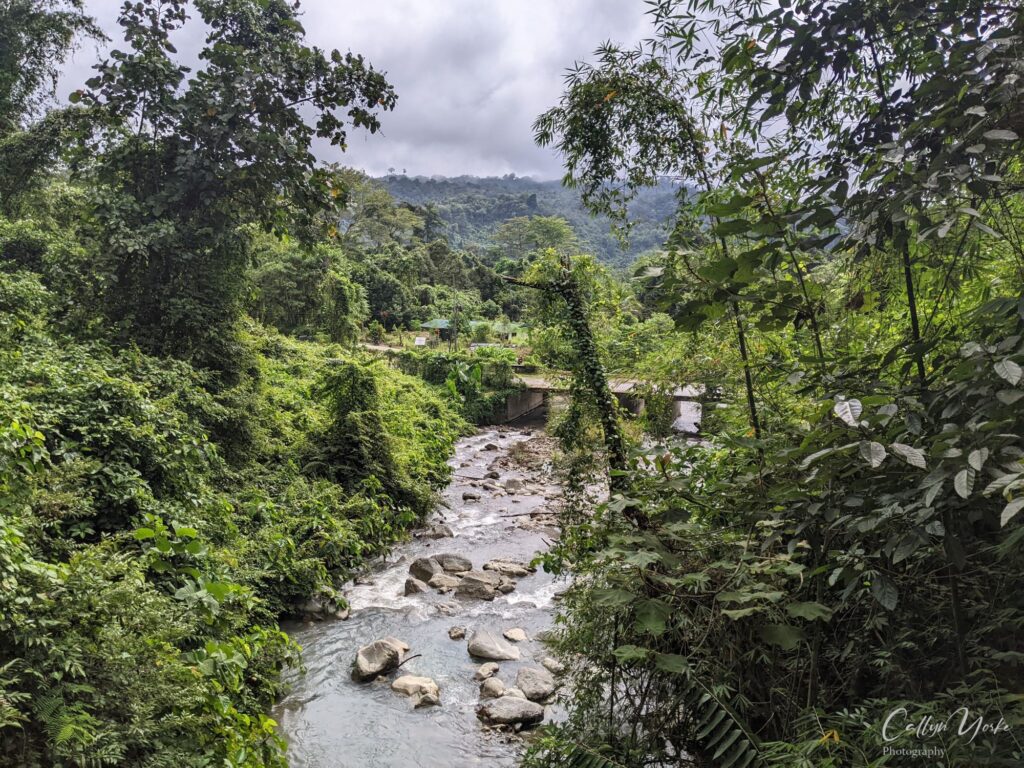
The remainder of Sabah awaited discovery. The present journey of nearly seven weeks in duration provided flexibility for further exploration. But even in that fair span of time some of the key natural areas would be skipped, e.g. Tabin Wildlife Reserve and the bird photography hides of Telupid. That could conveniently be blamed on floods, landslides, regional power outages and lack of lodging availability (mostly due to my habit of seeking last minute bookings).
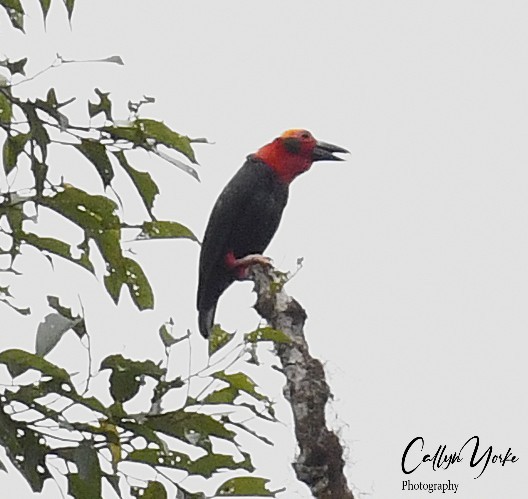
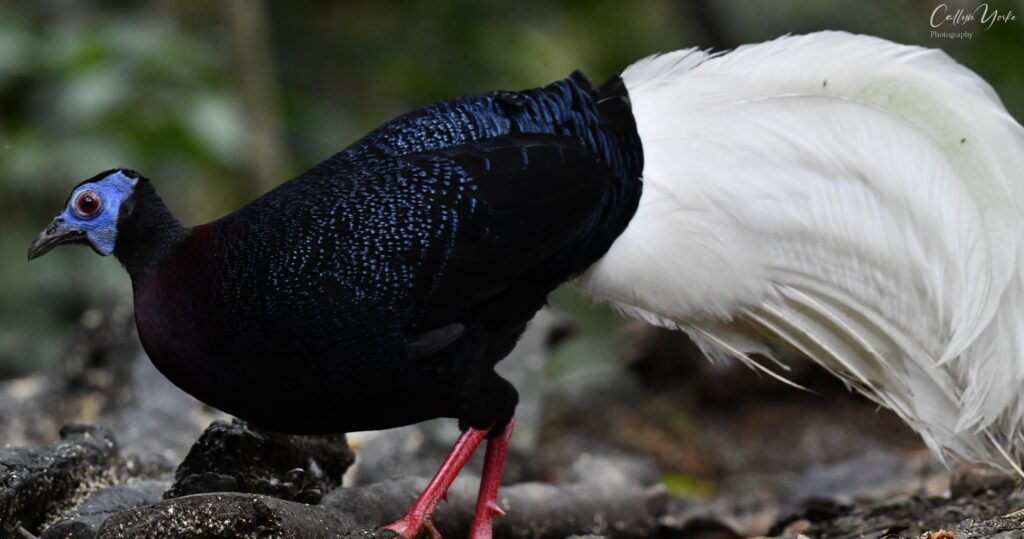
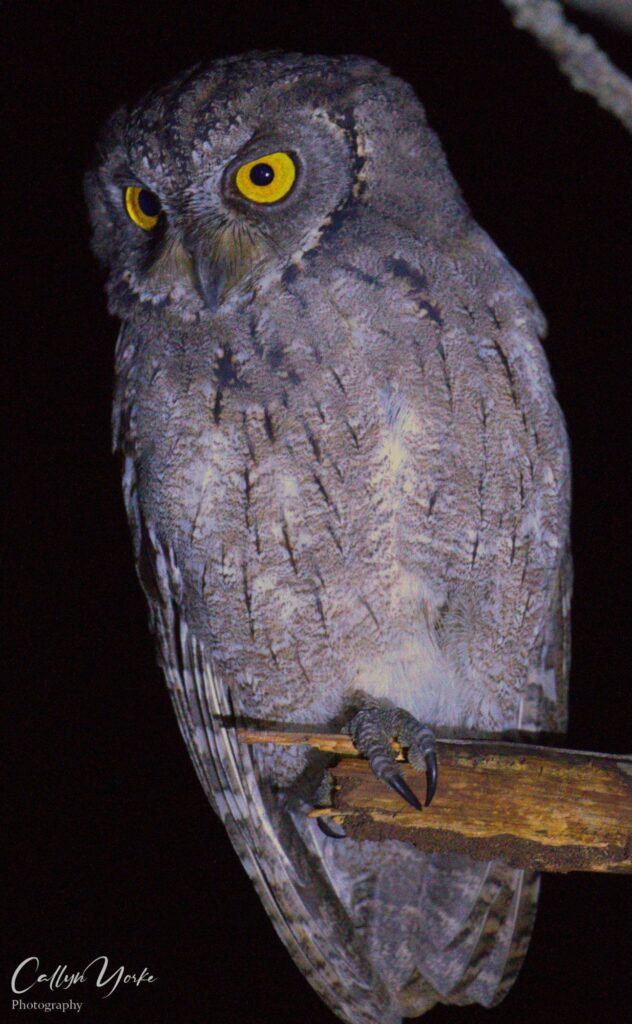
In the balance, revisiting Sabah as a lone traveler with an unstructured itinerary was definitely a worthwhile and memorable experience. As expected, traveling solo without reservations incurred multiple frustrations and inconveniences. The trade-offs were exciting discoveries and surprise encounters with Bornean endemics and rarities. Some of those birds and mammals were missed during my initial tour in 1980, such as Bulwer’s Pheasant, Bornean Ground Cuckoo, Mantanani Scops Owl, Bornean Bristlehead, Yellow-throated Marten, Marbled Cat and Whitehead’s Tufted Pygmy Squirrel.
ON LOCATION
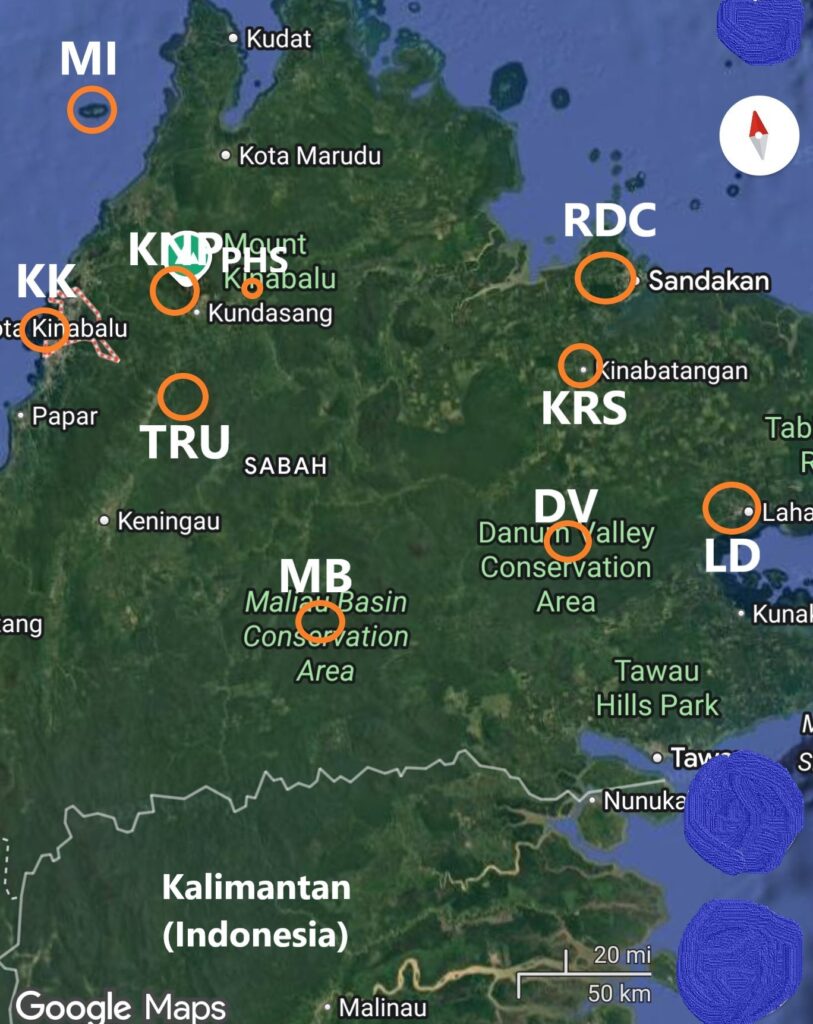
The following links to Sabah survey locations with annotated bird lists, are given in chronological order (see preceding map). Return visits are included with the main area headings. Throughout the journey, I used field notebooks, a hand-held DSLR camera (Nikon D850 coupled with a Nikon PF 500 mm lens), Zeiss 10 x 42 binocular and a Google Pixel 3X and Google Pixel 7 Pro cell phone for navigation and general photography. I also carried a waterproof (dry) bag and umbrella – both of which were often essential.