Ngọc Linh, Kon Tum Việt Nam June 16-17, 2025 Callyn Yorke
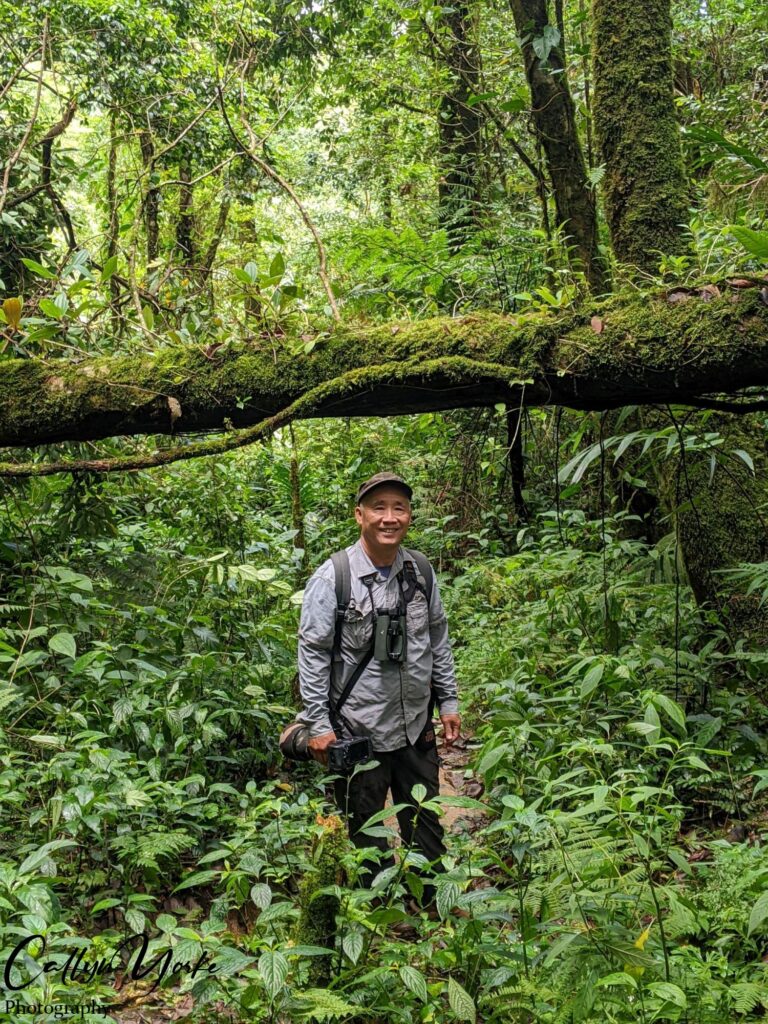
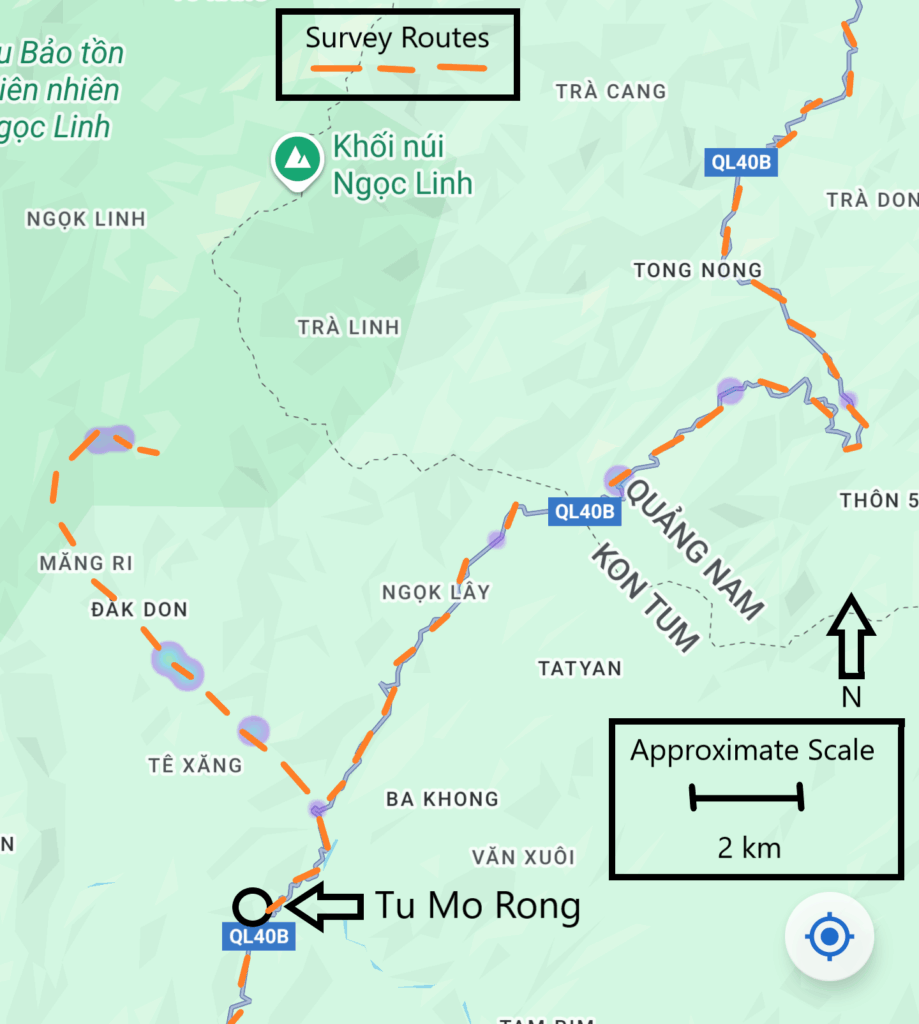
After our final morning birding session in Yok Đôn National Park, Đắk Lắk, Lê Quý Minh and I checked out of the visitor’s center lodge and spent the remainder of daylight hours in transit by automobile to our next destination, Tu Mơ Rông, Kon Tum Province. Thanks to Typhoon Wutip, we had sheltered during the week in western Đắk Lắk. An abbreviated schedule meant we would be birding the Ngọc Linh area for only about a day and a half. Minh reckoned it was enough time to find the specialty forest birds, in particular, the endemic Golden-winged Laughingthrush and near-endemic Black-crowned Barwing, which were much anticipated life-birds for me. The pristine, highland rainforest of Ngọc Linh, according to Minh, was the only place where I had a reasonable chance to see the former of those two celebrity species.
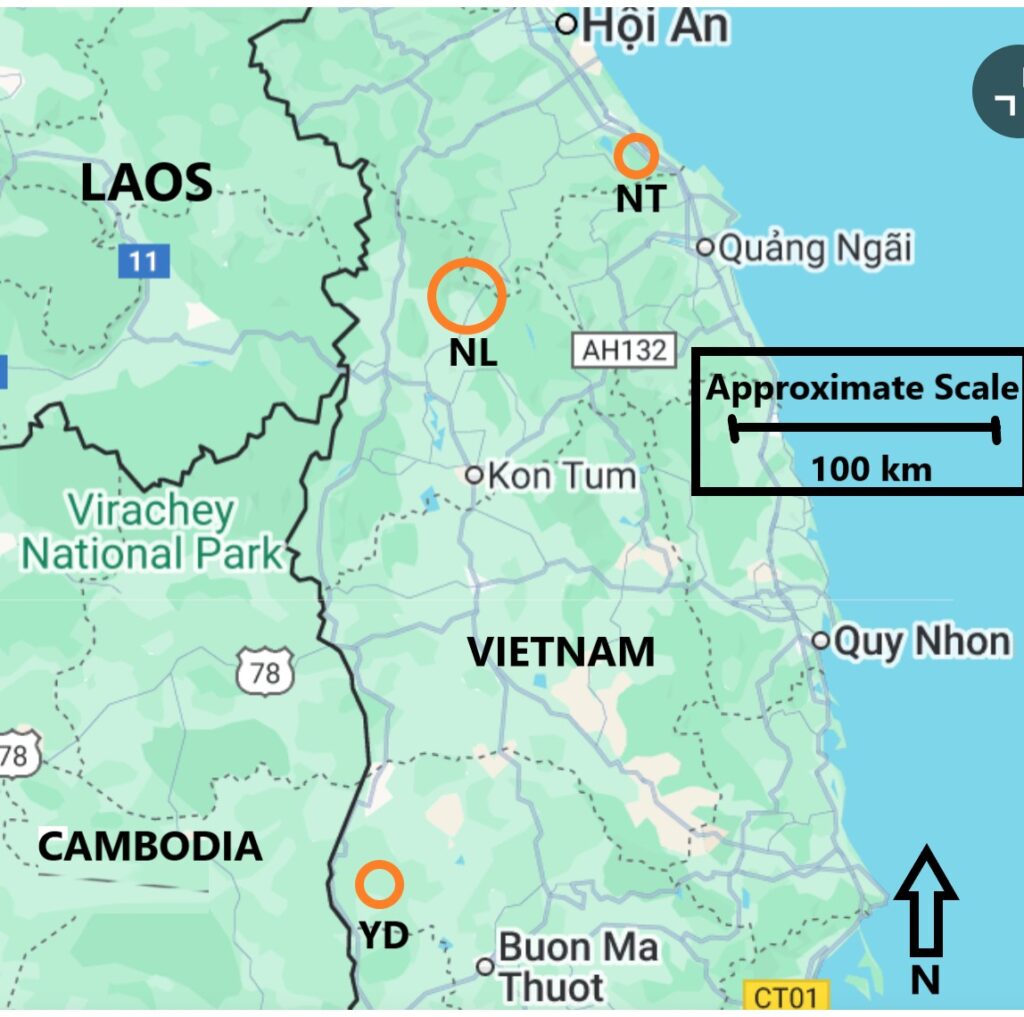
There wasn’t much traffic on the twisty mountain road out of Kon Tum city. We were entering a comparatively low population density area of Việt Nam, generally known as the Central Highlands. It had been a long day in the car and both of us were in need of a good rest by the time we turned into the parking lot of the Tâm Phụng Hotel, Tu Mơ Rông. Minh had confirmed our reservations by phone. This was Tu Mơ Rông‘s biggest hotel, actually, the newly relocated town’s only hotel. Most of the rooms were vacant and would remain that way during our visit. For a town on the main inter-province highway, it was atypically quiet.
The friendly hotel owners, Tâm and Phụng, remembered Minh from his previous bird tours in the area. They greeted us warmly and were busy preparing a multi-course Vietnamese-style meal. Hotel Tu Mơ Rông, at an elevation of 1,085 m, would be an ideal base camp for our Ngọc Linh expedition.
We were given keys to adjacent upstairs rooms. Mine was immaculately clean and comfortable. The bathroom was definitely an upgrade compared with the spartan lodging we had experienced at Yok Đôn National Park. At last, I had ample floor space for a splashy hot shower, partly because there was no trash container to stumble over.
That missing item was a little odd. The only trash receptacle I could find was a small, flip-lid can outside the room. Where was the used toilet paper supposed to go? Most visitors learn, on their own or from an emergency clean-up crew, that small-caliber plumbing is the industry standard in Việt Nam. I went next door to see the answer-man. Minh seemed surprised by my question. Suddenly, I was an untrained toddler. He instructed me to simply flush the paper down the toilet. Seriously? I was praying that the toilet wouldn’t find the cultural wipeout too difficult to swallow.
We enjoyed our evening meal in the kitchen-dining area, located in a separate building next to the hotel parking lot. Minh mentioned that the consolidated establishment was originally a karaoke nightclub. A stack of stereo speakers suggested we might be in for a long night. Mercifully, we were spared late night entertainment. I guessed we were in Tu Mơ Rông during a rare, sleepy-little-town spell. Everything, including the social atmosphere, service and plumbing facilities, flowed smoothly at Hotel Tu Mơ Rông.
The following morning, we set off on the main road in Minh’s Mitsubishi SUV. We cruised slowly with the windows down, watching and listening for birds. Our driving route bisected what remained of the original town of Tu Mơ Rông and skirted the scenic mountain hamlet of Măng Ri. Villagers were loitering on the roadside; some were climbing the rice terraces. Minh said that these ethnic people, called Xơ Đăng, provided the main labor force for local ginseng corporations.
We hadn’t gone far when a series of landslides required of Minh a bit of off-road driving skill. Apparently, such inconveniences were common. If you were driving a car through this area, it had better have high ground clearance, or you might be selling it to the locals for parts. Forget being in a rush for work. A three-legged dog could get through Măng Ri faster than anyone traveling by car or bus.
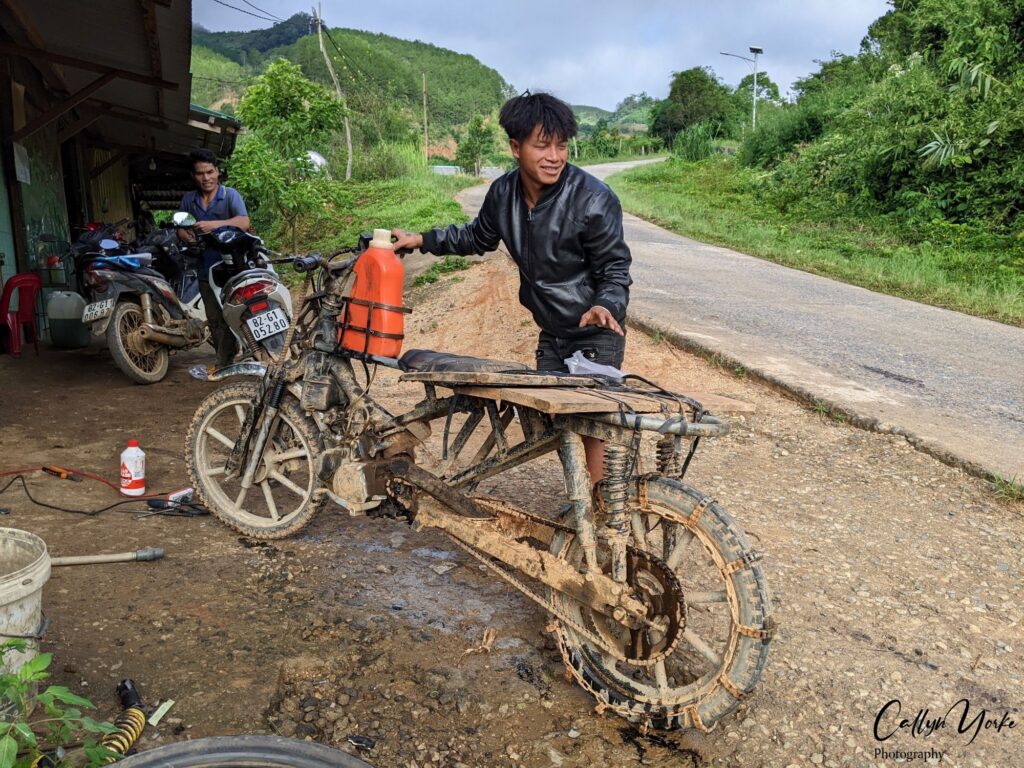
Locals were used to all of this. Resourceful ginseng workers had rebuilt their 100 cc motorbikes, refitting them with a custom extended frame and carrying rack, portable plastic fuel tank, iron rebar front-fork stabilizers and an oversized rear wheel with tire chains. Non-essential decorative parts, engine and gearbox covers, lights, chain guard and rear fender, were removed. All of those deletions and modifications, in order to better negotiate the impossibly steep, rocky terrain. These fearless dudes had taken motocross to another level.
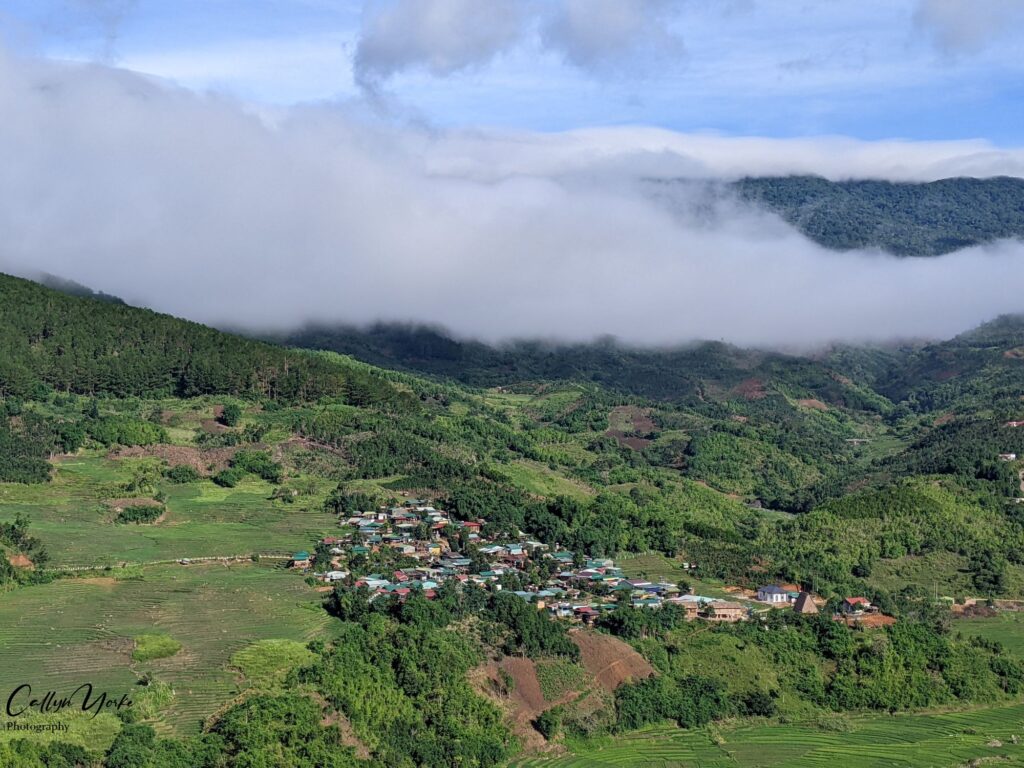
In view of the transformed landscape, resembling a scarily freakish haircut, the explanation for nearly impassable roads and relocated towns, was obvious. The settlement of Măng Ri, once nestled within a broad-leaved evergreen forest – a wonderfully biodiverse watershed – was now by surrounded by a mosaic of bare ground, taro and rice terraces, corn fields and scattered pine plantations. In the distance, hill tops with sparse stands of forest separated drifting layers of low clouds, like disappearing islands in the sky. It wouldn’t take much of a storm to move tons of soil and rock downhill, as had evidently happened during the recent typhoon. Măng Ri was another familiar setting for a VTV1 flood and landslide story. Perhaps the villagers had found themselves more than once on the Chào Buổi Sáng national TV news.
There was another issue related to land use. A few kilometers from Măng Ri, an impressive old-growth montane forest invited exploration. However, accessibility presented a problem. Some years earlier, the government had divided up the land. Now, the forest was partly owned and protected by the village community and partly by the Việt Nam National Park Service. A thoughtful political move, presumably intended to promote equitability and natural resource conservation. But without clear signage and boundary markers, jurisdictional rules remained unclear, especially for uninformed visitors.
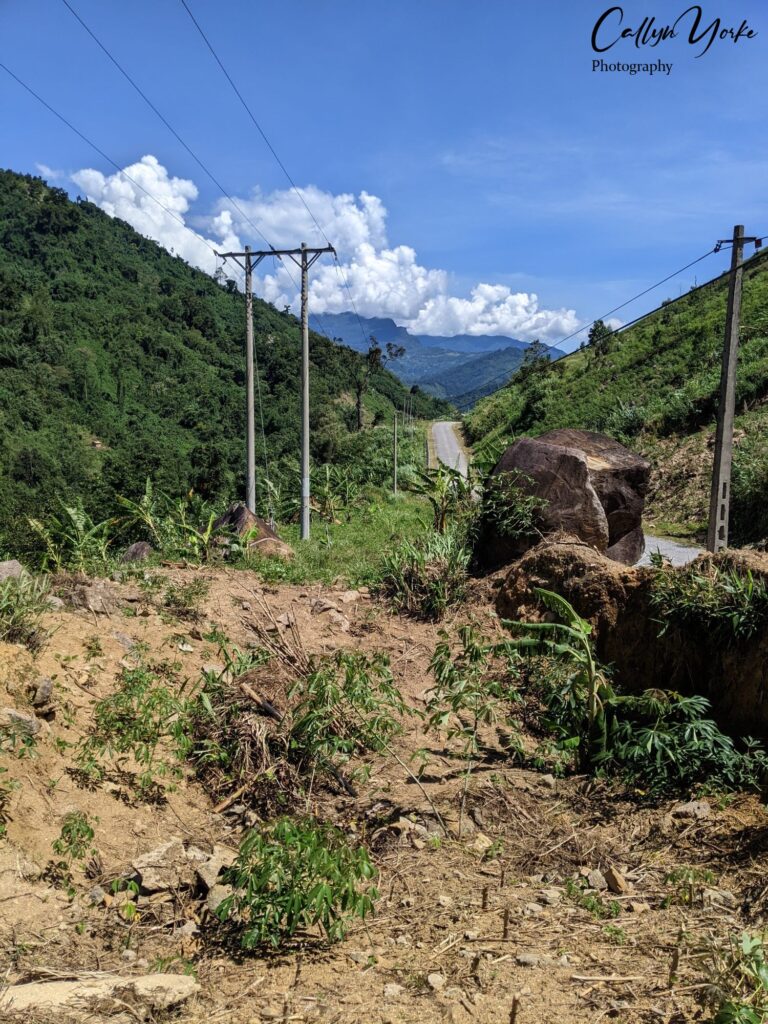
Initially, we birded along a paved highway through the Ngọc Linh forest that was more or less a demilitarized zone. We marveled at a panoramic view of the forested mountains and valleys. Such vast wilderness scenes were few and far between in Việt Nam. I asked if there were trails we could use in the forest. Minh shook his head and lamented that, even though most the area around us was officially national park land, there were no public trails or visitor facilities. Roadside birding was ostensibly the best option in Ngọc Linh. I had an uneasy feeling Minh hadn’t told me the whole story. Eventually, that bombshell landed.
There were new, unpublicized, strictly enforced regulations; all of those could be essentially summarized as, Rule #1: Entering the forest anywhere in Ngọc Linh without committee approval, is taboo. Vietnamese Ginseng (Panax vietnamensis), an endemic medicinal plant, discovered on Mt. Ngọc Linh in 1975, was being commercially cultivated in the forests. Trails were monitored and regularly patrolled. Locals also watched the roadways. Unrecognized vehicles were an immediate cause for concern. Outsiders found in the forest, whether day-hikers or birders harmlessly seeking a glimpse of a Golden-winged Laughingthrush, would be apprehended and either asked to leave or escorted to the village council for interrogation. Minh had already learned that lesson the hard way.
Some time ago, there was an incident involving Minh while he was birding in the vicinity of the National Park. An angry group of locals cornered him and forced him to abandon his birding in Ngọc Linh. He was given no other option but to leave the area. Subsequently, Minh returned and met with community forest officials. Using skillful diplomacy, he managed to obtain temporary permission to visit with his birding clients.
For now, the accessibility issue was settled and we weren’t expecting any heat from the locals. Minh had notified the community officials of our intent to search for birds on one of the forest trails. They knew we were coming and probably would be checking up on us.
Sure enough, we hadn’t been birding the roadway more than ten minutes, when two locals, one wearing a park ranger outfit, approached us and engaged Minh in a brief inquiry. It was clear that, if visitors thought that the dreamy, epiphyte-laden forests of Ngọc Linh were accessible for birding and other recreational activities, they were in for a rude awakening. Presently, it appears as though it may take a few more years to sort out all the complex land issues in order to improve public access to Ngọc Linh.
Our initial birding session along the Ngọc Linh highway was sporadically productive. We had brief views of small passerines, e.g. Indochinese Fulvetta and Blyth’s Leaf- warbler, moving quickly through the understory and outer canopy, respectively. Most of the birds vocalizing in the distance were unresponsive to Minh’s playback recordings.
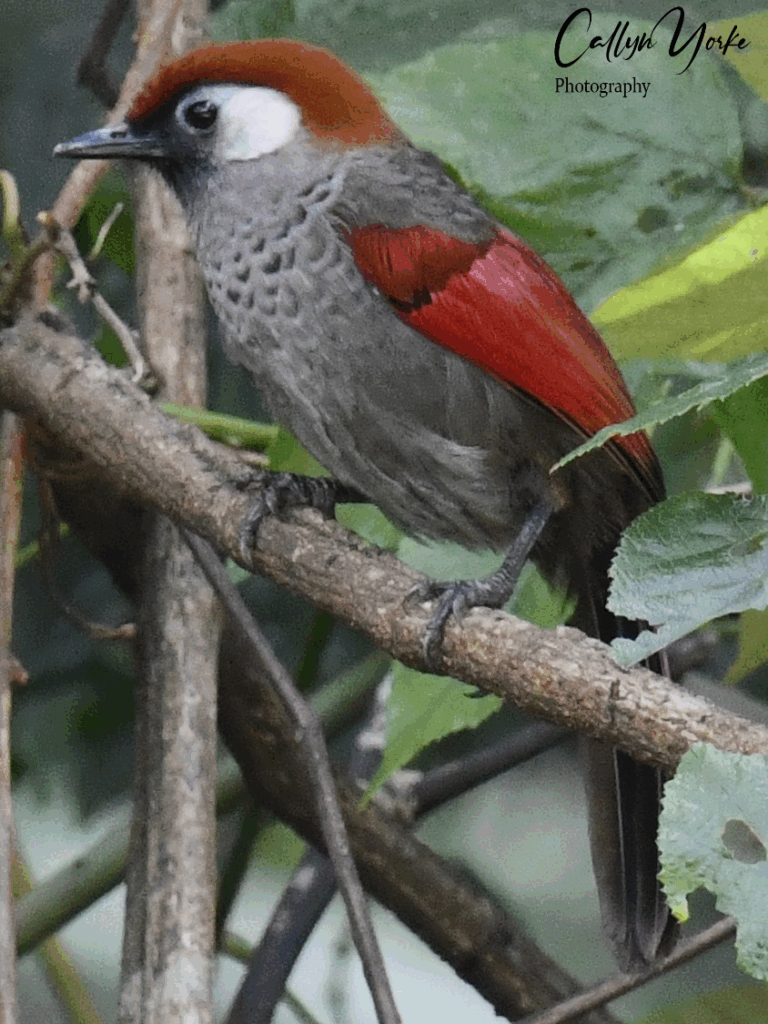
The delightful exception was a small flock of Red-tailed-Laughingthrush. Minh had been broadcasting playback of their musical renditions. The birds must have been quite some distance from us to begin with because they didn’t show up to investigate the playback sounds for at least fifteen minutes. We had almost given up on seeing them. After playing hide-and-seek with us for a while, the birds finally came in close to the roadway, keeping to the forest edge and allowing multiple photo opportunities. In my view, the Red-tailed Laughingthrush was one of the more elegantly adorned members of its family, and one of my most memorable life-birds.
Minh and I continued driving on the Ngọc Linh highway until reaching a roadside pull-out. From there we would proceed again on foot. This time, our destination was a secluded forest trail where Golden-winged Laughingthrush was known to occur. Minh had deliberately parked his vehicle about 100 m uphill from the forest trailhead, so as to minimize the chance of being intercepted by local patrols. That was a wise move on his part and, although we were likely being watched closely, we had the first kilometer of the trail to ourselves for the next two hours.
The ‘laughingthrush trail’ – rugged and drenched from recent rains, transected one of the most magnificent old-growth stands of highland rainforest remaining in Việt Nam. Looping lianas framed the forest mid-levels and tree limbs sagged beneath the weight of epiphytes. Diffuse light from overcast skies flickered down through the canopy of widely varying heights, maxing out at about 25 m. Some of the largest trees, e.g. with a diameter breast height (dbh) of > 2 m, may have been a century old, though that would be only a wild guess. With year-round growth, seasonal tree rings are almost impossible to count. Tree growth is rapid in these wet tropical forests and, combined with relatively shallow top soils and steep slopes, limb breakage and tree falls are frequent. ‘Old-growth’ might be somewhat of a generalized misnomer. Montane forests may actually be dominated by much younger age classes of trees than lowland forest counterparts.
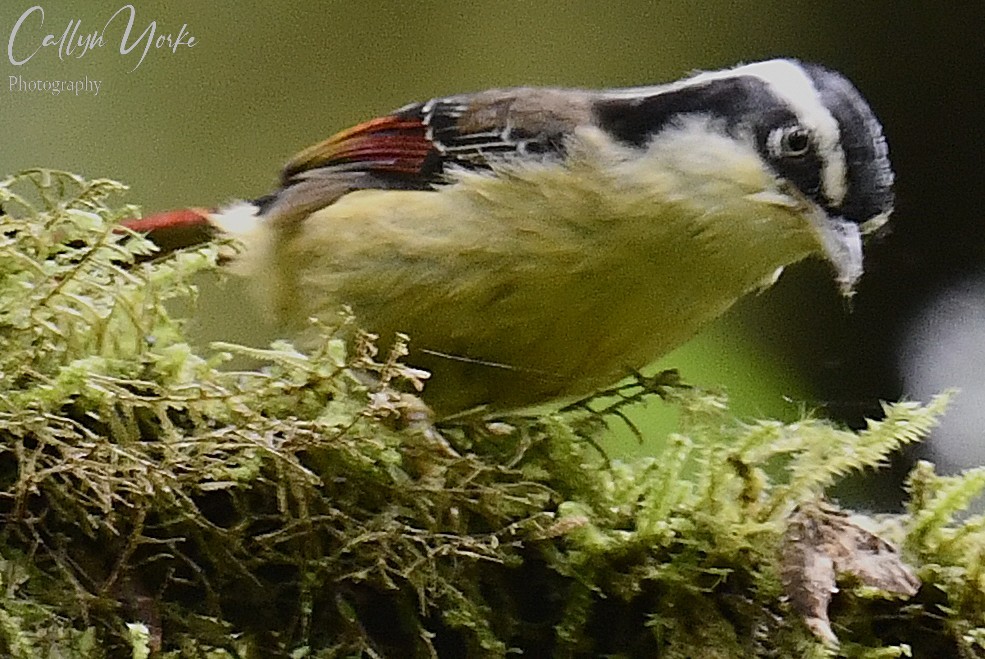
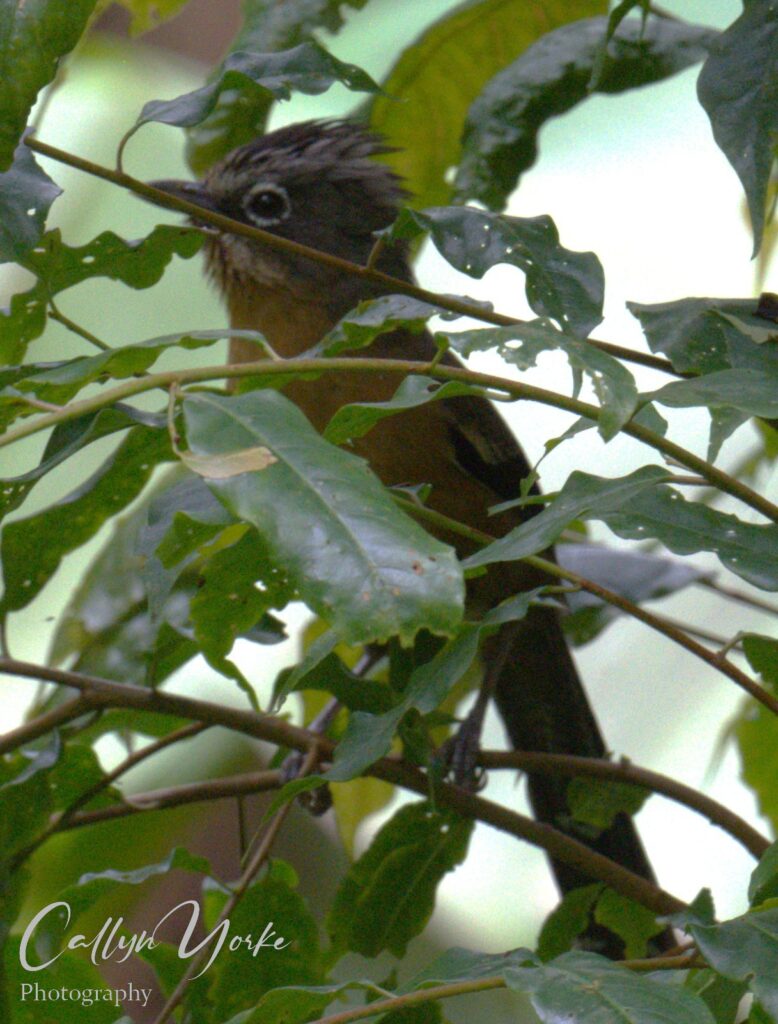
Minh pointed out that recent high winds from a typhoon had downed branches and a few trees, creating openings in the forest. Those sunlit patches attracted mixed species flocks. One of the ‘bird waves’ included a Red-tailed Minla, in the process of pecking to death and consuming a large moth. In the otherwise shady forest, this was a rare opportunity for action photography. And, as a bonus, it was a life-bird I had wished to see. On our return hike down to the trailhead, yet another new bird appeared – Black-crowned Barwing. Appropriately, the species binomial ‘sodangorum,’ is the phoenetically Latinized version of, ‘Xơ Đăng,’ acknowledging the local indigenous people who are the designated protectors of the bird’s habitat.
Fallen limbs and wet foliage impeded our forward progress on the trail. Invisible, ankle-twisting obstacles were everywhere. Multiple brooks, appearing easily crossed, concealed algae-slick stones. We were often required to lend each other a steady hand. Sneaky leeches awaited attachment to our wet clothing. Obtaining traction on some of the steep sections was comically futile.
Grabbing anything upright that wouldn’t immediately uproot or give way to a landslide, we scrambled up the trail. Finally, we stopped to catch our breath near the place where Minh thought we might find the prized bird. I checked my altimeter:1,895 m. We were within the preferred elevational range of the Golden-winged Laughingthrush. Imagination and anticipation were in sync with my elevated heart rate and blood pressure.
We had earned a few moments of silent reflection. The astounding biodiversity and overwhelming verdant luxury of this forest contained a sobering reminder. We were witnessing a small, surviving sample of all that had disappeared in historical times. From a national perspective, I wondered if even one percent of the current population of Việt Nam (about 100 million) would ever see this amazing forest and so begin to appreciate the magnitude of what the country had lost. Natural history education in schools, including field trips guided by forestry biologists, would appear to be a crucial step toward preserving these and other wilderness areas in Việt Nam.
Minh motioned for me to be still. He had recognized the nearly inaudible sounds of a Golden-winged Laughingthrush. I was unsure if I had heard anything besides the snap of a branch underfoot. Forest acoustics can be deceptive. A singing bird might seem close when it is actually much further away – and vice-versa. One might be certain a bird is vocalizing near the ground when it is looking down from the canopy at your foolish, sweaty face. Of course, Minh had spent enough time with forest birds to be mindful of their ventriloquisms.
Despite Minh’s efforts, a series of playback recordings failed to bring our mysterious feathered beauty into view. Minh went ahead on the trail, while I awaited his signal. Nothing. And after waiting patiently for another thirty minutes, we realized that the bird would probably be a no-show. Within the birding community, truth be told, it was an unforgettable and in some elite circles, unspeakable dip. I had been stood up – catfished – on a blind date.
I glanced at Minh as he adjusted his cap, half expecting him to show some sign of disappointment. Nope. He looked as calm and thoughtful as ever. These things happen when birding. Quite possibly, with our decision to abandon hope and return down the trail, we were, each in our own way, solemnly considering ancient yin & yang wisdom: With every failure and breakdown, a new opportunity for resolution and success will present itself. Looking on the bright side, the absentee bird was an excellent motivator for returning one day; if for no other reason than to enjoy a unique wilderness experience in an absolutely wonderful Vietnamese rainforest.
A light drizzle began falling as we hustled up the roadway. Dark-bellied clouds were drifting in rapidly from the north. We reached the car doors just before getting soaked. Our day of birding in Ngọc Linh was finished. We drove back to Tu Mơ Rông mostly in silence. Soon, we would be packing for an early morning departure to the coast.
The next morning, Minh figured our time traveling would be best spent at some new locations on the road, bypassing Ngọc Linh and heading northeast. We had more than one-hundred km to cover, mainly on slow mountain roads. It would be a tight birding schedule, if we were to find accommodations in Núi Thành before dark. After breakfast, we said our goodbyes to the kind folks at Hotel Tu Mơ Rông and continued on our Việt Nam road trip.
The lengthy drive from Tu Mơ Rông to Núi Thành was tedious, as expected, though not without birding highlights. The first one was still within sight of Tu Mơ Rông. Above a fast flowing river, birds were vocalizing in a small patch of pine woodland with an understory of shrubby second-growth. There, we tallied what might have been a new Việt Nam record for the number of bird species in a mixed-species flock: Nineteen. It was definitely a personal record for me. Included in the lively assemblage, were birds new for our trip list, e.g. White-browed Piculet, Clicking Shrike-babbler, White-throated Fantail, Lesser Racquet-tailed Drongo, Indian White-eye, Black Bulbul, Hill Prinia, Plain Minla, and White-browed Scimitar-babbler.
The next big surprise happened around 0930 hrs., northbound on HWY QL 40B, in Quảng Nam Province. We slowed then stopped at a road repair site. A flock of Red-rumped striated Swallow was on the edge of a puddle in the roadway, gathering tiny morsels of mud, presumably for nest-building.
While I was preparing to photograph the swallows, Minh excitedly called out, “Rufous-cheeked Laughingthrush! Did you hear them?” I put glass on the distant ridge and listened intently. Minh began playback recordings of their melodious vocalizations. I heard only a faint response, certainly nothing definitive. Neither could I see any movement in a dense patch of woody second-growth. Nevertheless, Minh was sure of the identification and announced that this was a new, southerly range record for that species in Việt Nam. I documented the coordinates (15.17°N, 108.534°E), altitude (1,065 m) and obtained cell phone images for the record. It was our last notable ornithological event until arriving in the coastal wetlands of Núi Thành that afternoon.
____________________________________________________________
ANNOTATED BIRD LIST: Ngọc Linh, 16 -17 June 2025 Callyn Yorke
KEY TO ANNOTATIONS
Observer noted when only one of us encountered the bird: Lê Quý Minh (LQM); Callyn Yorke (CY)
Bird Behavior: greg. = gregarious; msf = mixed species flock; agl = estimated height above ground level (m); voc. = vocalizations, i.e. calls and/or song; HO = heard only.
Numerical abundance, frequency and distribution: Highest number of individuals found and counted at the first indicated location in a sequence.
Systematics and Taxonomy is an amalgam of the most recent (2025) online lists by Birdlife International, AVIBASE and International Ornithological Congress (IOC).
BIRDS
PIGEONS AND DOVES Columbidae
- Zebra Dove 1 on roadside, MR.
CUCKOOS Cuculidae
- Greater Coucal 1 voc. (unseen) TMR; NL.
TYPICAL OWLS Strigidae
- Asian Barred Owlet Glaucidium cuculoides 1, an individual in a patch of pines, mobbed by several small passerines in a msf, TMR; NL
HAWKS AND EAGLES Accipitridae
- Black Eagle 1 Ictinaetus malaiensis 1 one circling 50m agl, MR.
KINGFISHERS Alcedinidae
- White-breasted Kingfisher Halcyon smyrnensis 1 voc. (unseen) TMR; NL.
ASIAN BARBETS Megalaimidae
- Green-eared Barbet Psilopogon faiostrictus 1 in low flight across the road, TMR
- Annam Barbet Psilopogon annamensis 2 voc. TMR; NL
- Necklaced Barbet Psilopogon auricularis 1 voc. msf TMR; NL.
WOODPECKERS Picidae
- White-browed Piculet Sasia ochracea 1 msf with several passerines in a pine woods patch, TMR.
VIREOS Vireonidae
- Black-eared Shrike-babbler Pteruthius melanotis 1 (LQM) msf in forest tree-fall clearing, NL.
- Clicking Shrike-babbler Pteruthius intermedius 1 msf in pine woods patch with 18 other bird spp., TMR.
CUCKOOSHRIKES Campephagidae
- Scarlet Minivet Pericrocotus speciosus 2 (m,f) greg. voc. NL; TMR.
- Black-winged Cuckooshrike Lalage melaschistos 1 TMR; NL.
VANGAS AND ALLIES Vangidae
- Bar-winged Flycatcher-shrike Hemipus picatus 1 in msf with 18 other bird spp. in a pine patch, TMR
FANTAILS Rhipiduridae
- White-throated Fantail Rhipidura albicollis 2 voc. in msf with 18 other bird spp. pine woodland patch, TMR.
DRONGOS Dicruridae
- Sooty Drongo Dicrurus leucophaeus 1 in canopy of forest edge, NL.
- Lesser Racquet-tailed Drongo Dicrurus remifer 1 voc. msf pine woods patch with 18 other bird spp., TMR; NL.
SHRIKES Laniidae
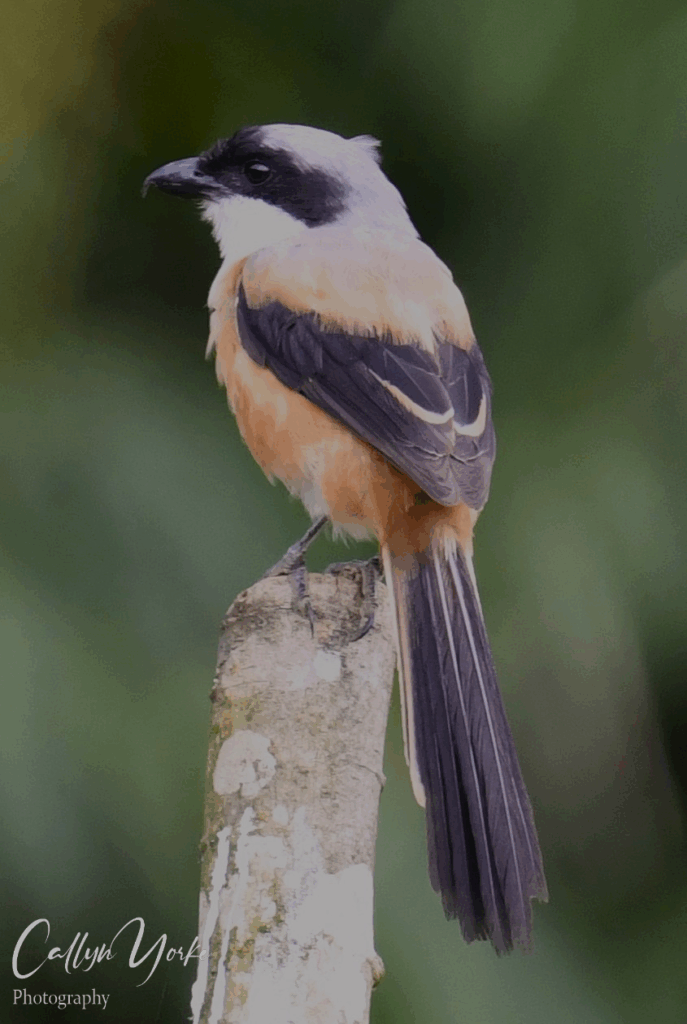
- Chinese Long-tailed Shrike Lanius schach 5 greg. open areas, agricultural fields, on roadside fence and other medium-low perches, ubiq. (photo).
CROWS AND JAYS Corvidae
- Eastern Jungle Crow Corvus levaillantii 1 flying over forest, NL.
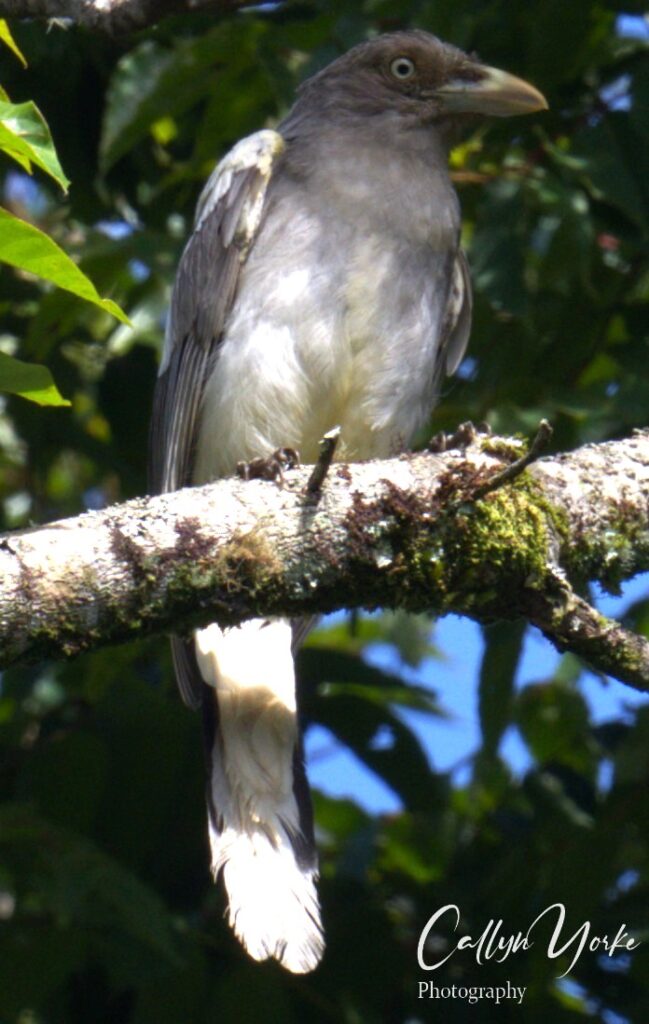
- White-winged Magpie Urocissa xanthomelana 5 voc. greg. roadside forest edge, N QL 40B (photo).
TITS Paridae
- Yellow-browed Tit Sylviparus modestus 1 in deep forest, mid-level, NL.
- Yellow-cheeked Tit Machlolophus spilonotus 1 (LQM) msf, forest canopy, NL.
CISTICOLAS AND ALLIES Cisticolidae
- Rufescent Prinia Prinia rufescens 2 voc. roadside second-growth, TMR.
- Hill Prinia Prinia superciliaris 4 voc. (unseen) roadside grass and shrubs, TMR; MR.
- Common Tailorbird Orthotomus sutorius 5 voc. TMR; MR.
GRASSHOPPER-WARBLERS AND GRASSBIRDS Locustellidae
- Locustella sp. voc. – LQM (unseen) roadside grass & shrubs, TMR.
SWALLOWS AND MARTINS Hirundinidae
- Eastern Red-rumped (striated) Swallow Cecropis daurica 8 greg. gathering mud from puddle; 6 alighting on thatched roof of community house, N QL 40B; TMR.
BULBULS Pycnonotidae
- Black-crested Bulbul Pycnonotus flaviventris 1 voc. roadside forest edge, NL.
- Flavescent Bulbul Pycnonotus flavescens 12 voc., msf, pine woodland patch with other passerines, TMR; MR; NL.
- Black Bulbul 10 greg. voc. msf in a pine woodland patch with 18 other bird spp., TMR.
LEAF WARBLERS Phylloscopidae
- Gray-cheeked Warbler Phylloscopus poliogenys 1 msf at roadside second-growth, mixed broadleaved and pine woods; interior tree fall clearing, TMR; NL.
- Blyth’s Leaf-warbler Phylloscopus reguloides 1 msf in forest canopy and second-growth at roadside, NL; TMR.
BUSH WARBLERS Scotocercidae
- Gray-bellied Tesia Tesia cyaniventer 1 voc. (unseen) roadside second-growth forest; forest edge; TMR; NL.
- Mountain Tailorbird Phyllergates cucllatus 1 voc. msf pine woodland patch with i8 other bird spp., TMR; NL.
OLD WORLD WARBLERS AND PARROTBILLS Sylviidae
- Indochinese Fulvetta Fulvetta danisi 3 voc. greg. roadside forest understory, NL.
YUHINAS and WHITE-EYES Zosteropidae
- Black-chinned Yuhina Yuhina nigrimenta 1 (HO – LQM) NL.
- Indian (Oriental) White-eye Zosterops palpebrosus 6 greg. msf with 18 other bird spp. in pine woodland patch, TMR.
SCIMITAR-BABBLERS AND ALLIES Timaliidae
- White-browed Scimitar-babbler Pomatorhinus schisticeps 1 (HO) msf in a pine woodland patch with many other bird spp., TMR.
- Coral-billed (Black-crowned) Scimitar-babbler Pomatorhinus ferruginosus 1 (HO – LQM) roadside second-growth, TMR.
- Pin-striped Tit-babbler Mixornis gularis 1 voc. (HO) roadside second-growth and woodland edge, TMR.
GROUND BABBLERS Pellorneidae
- Rusty-capped Fulvetta Schoeniparus dubius 2 greg. msf stauing low in deep forest understory, NL.
- Rufous-winged Fulvetta Schoeniparus castaneceps 5 greg. staying in middle to low understory at roadside forest edge, NL.
- Spot-throated Babbler Pellorneum albiventre 1 (HO – LQM) roadside second-growth, TMR.
- Buff-breasted Babbler Trichastoma tickelli 1 voc. (unseen) roadside second-growth, TMR.
LAUGHINGTHRUSHES AND ALLIES Leiothrichidae
- Rufous-cheeked Laughingthrush Garrulax castanotis (HO – LQM) hillside second-growth broadleaved forest, N QL40B, 15.17N, 108.534 E, @ 1,065 m, Quang Nam.
- White-cheeked Laughingthrush Garrulax vassali 3 + voc. greg. roadside second-growth, TMR.
- Red-tailed Laughingthrush Trochalopteron milnei 4 greg. voc. pos. response to rec. playback; flying from forest to roadside forest and second-growth, NL.
- Golden-winged Laughingthrush Trochalopteron ngoclinhense 1? (HO – LQM) deep, shady forest @ 1,895 m, NL.
- Black-headed Sibia Heterophasia desgodinsi 2 greg. a pair moving quickly through the forest edge canopy, NL.
- Silver-eared Mesia Leiothrix argentauris 2 voc. roadside second-growth and forest edge, TMR; NL.
- Rufous-backed Sibia Leioptila annectans 1 (HO – LQM) roadside second-growth, TMR.
- Red-tailed Minla Minla ignotincta 1 in msf, forest tree-fall clearing; consuming a large moth, NL.
- Plain Minla Siva orientalis 1 (CY) in msf canopy and subcanopy pine woodland, TMR
- Black-crowned Barwing Actinodura sodangorum 2 greg. a pair shy, staying partly concealed in dense forest understory at the edge of a tree-fall clearing, NL.
STARLINGS Sturnidae
- Black-collared Starling Gracupica nigricollis 3 greg. in flight, MR.
- Chestnut-tailed Starling Sturnia malabarica 2 greg. on a roadside utility pole, NL.
- Vinous-breasted Myna Acridotheres leucocephalus 5 greg. in isolated tree canopies, TMR.
- Hill Myna Gracula religiosa 2 greg. a pair in a roadside tree canopy, NL.
OLD WORLD FLYCATCHERS AND CHATS Muscicapidae
- Large Niltava Niltava grandis 1 m deep forest near tree-fall clearing, NL.
- Verditer Flycatcher Eumyias thalassinus 2 forest canopy near roadside, NL; TMR.
- Hill Blue-flycatcher Cyornis whitei 1 msf in pine woodland patch, TMR.
- Snowy-browed Flycatcher Ficedula hyperythra 1 middle level of deep forest, NL.
SUNBIRDS Nectariniidae
- Streaked Spiderhunter Arachnothera magna 1 (HO – LQM) msf in pine woodland patch, TMR.
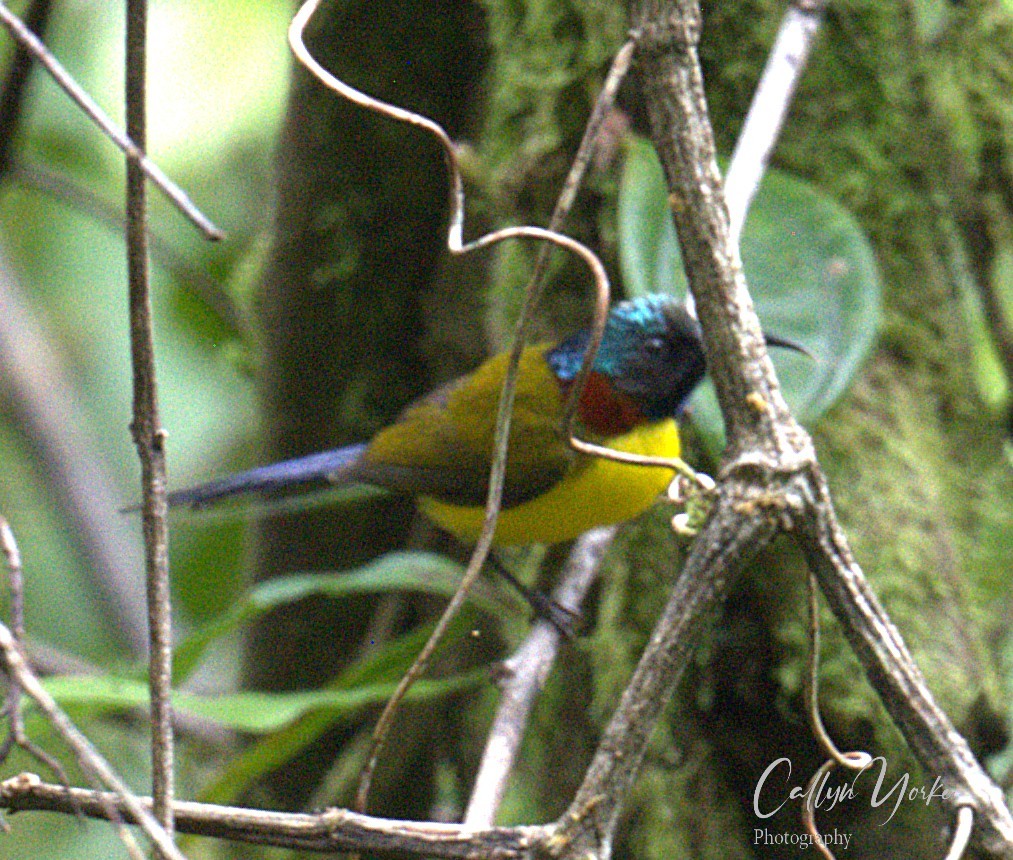
- Green-tailed Sunbird Aethopyga nipalensis 2 (m,f) highly active at edge of a forest clearing, understory, NL (photo); QL 40B.
WAXBILLS Estrilididae
- White-rumped Munia Lonchura striata 1 roadside second-growth, NL.
- Scaly-breasted Munia Lonchura nisoria 1 roadside second-growth next to a homestead, TMR.
OLD WORLD SPARROWS Passeridae
Eurasian Tree Sparrow Passer montanus 15 (m,f) greg. roadsides in villages and towns, ubiq..
___________________________________________________
LINKS TO REPORTS
Yok Đôn National Park, 10-15 June 2025
_____________________________________________________