Amazonas Brazil March 4-14, 2025 Callyn Yorke
Overview
The evening flight from Cuiabá to Manaus, via São Paulo, went without incident. By 1:30 am I was settled into a small, refrigerated room on the 4th floor of the Ibis Manaus Airport Hotel. The AC in my room had to be switched off to prevent my optical equipment from fogging up. Despite the microclimate adjustment, the icy air in the hallway kept the room cool and muggy all night. Condensation streamed down an opened window. I got a couple hours of rest before daybreak.
The hotel breakfast room had been prepped and was ready for early-bird customers at 6 am. A full breakfast buffet – Brazilian style – included deli meats, cheeses, bacon, eggs, fruit, yogurt, cereal, breads, cakes, pastries and coffee. This was the usual fare in Brazilian three-star hotels ($US 80-100/night). Airport hotels were open the earliest and usually had the best food selections. This one also had a decent restaurant with a varied menu. The service workers were friendly and efficient.
Nearby, was a tall secondary rainforest with parrots and other birds cruising over the canopy early in the morning. Most of the birds were a bit too far from my room window for positive identification. I asked an English-speaking hotel receptionist if it would be possible to walk around the neighborhood for birding. She replied, hesitantly, that should be okay.
However, heavy commute traffic on the highway outside the hotel made birding rather difficult, due to the noise. Also problematic, was the lack of walkways and pedestrian street crossings. After a couple of straddled guard rails and sprints across busy roadways, I ended up in a weedy, mosquito infested lot between the hotel and an auto repair shop. Local folks, apparently still asleep, occupied a corrugated metal shack partially shaded by papaya and banana trees. A few birds darted between the trees and shrubs.
Heavy humidity was combining with lack of sleep and my first birding adventure in Manaus was becoming less enchanting by the minute. A sudden thunderstorm had me scurrying back to the hotel for cover. Perhaps ten bird species were on my morning bird list; half of them were yet of uncertain identity. I was looking forward to the pre-booked taxi to the Refugio Mari-Mari birding lodge in the afternoon.
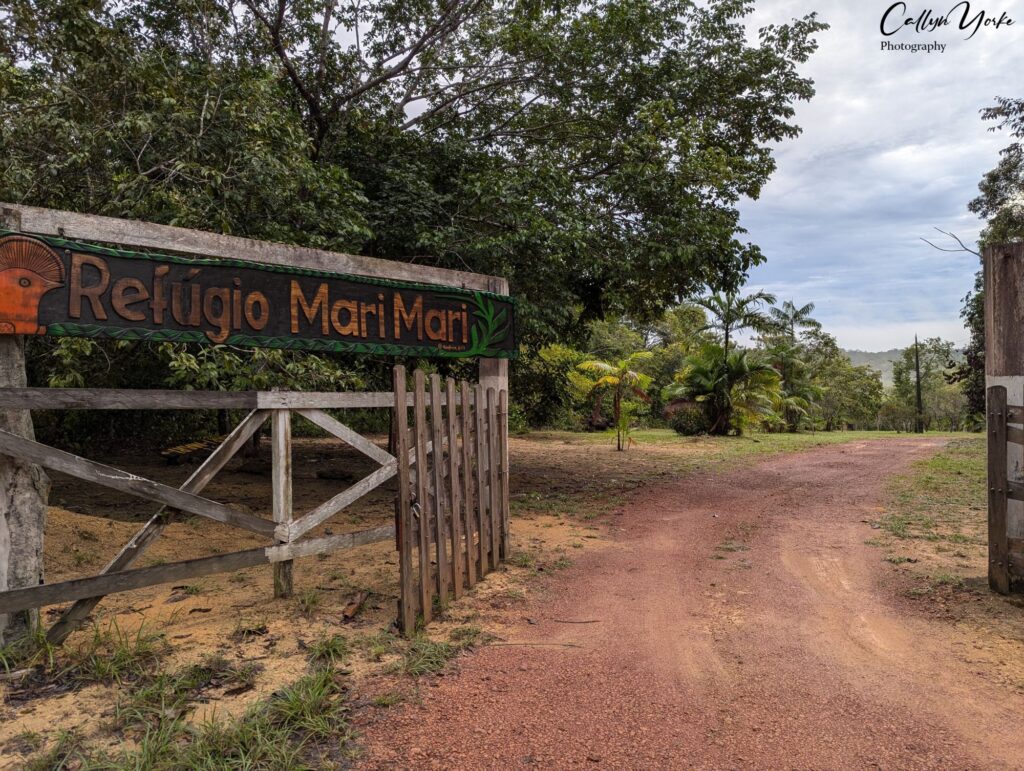
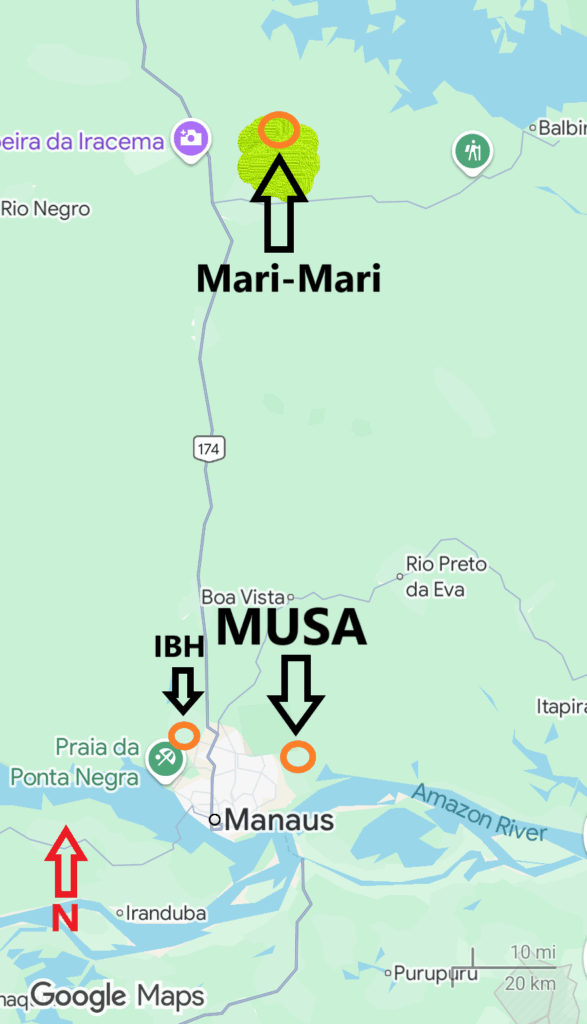
Except for a couple of visits to the Manaus Natural History Museum (MUSA, March 13 & 14 – see below), I remained at Refugio Mari-Mari. The place was well known to Brazilian bird guides, including the Mello brothers and the Friedlanders at Jamacá das Araras. With a bird list of around 400 species, Mari-Mari was certain to have a few new ones for the Brazil trip and probably for my life list as well. I guessed that a week spent birding at the lodge would be sufficient time for me to find most of the common birds and other wildlife known to occur in the area. That may well have been the case, had I enlisted the services of one or more professional bird guides.
Instead, I would be birding Mari-Mari mostly on my own, on foot, and using whatever reference material could be found online and in the Van Perlo bird book. Since I had birded the Peruvian and Ecuadorian Amazon in years past, I was fairly sure that I could refamiliarize myself with the avifauna at Mari-Mari. Due to the popularity of the place, I imagined that there might occasionally be assistance available at Mari-Mari for bird identifications.
Luiz, a local guide whom I had contacted earlier, dropped in with his client for an overnight visit at Mari-Mari. He mentioned finding birds in the area that I was fairly certain I had also seen but for which I had not yet made specific assignments. Luiz was very helpful and willing to review emails with my digital images.
No other birders came to Mari-Mari until near the end of my stay. Late one morning an enthusiastic birder showed up in the woods behind the reception building and began using playback recordings. His new outfit and audio equipment suggested those of a professional guide. He invited me to join him in a largely futile attempt to bring a Golden-headed Manakin into view. The bird, a potential lifer for me, kept its distance in the forest understory. After several minutes it was obvious that, visibly agitated by the playback of its vocalizations, the furtive manakin would not be approaching any closer.
Nor was I coming any closer to hiring a bird guide. When I returned from lunch, the young birder was gone. The following morning I had a brief but clear view of a female Golden-headed Manakin, so I felt somewhat vindicated. Each day, I had recognized a few more species and gained confidence by birding alone at Mari-Mari.
Victoria, the charming young lodge manager, had initially asked if I would like to hire a bird guide for Mari-Mari. Having already discussed that option with Luiz prior to the visit, I politely declined, believing that I would be most pleased when finding and identifying birds by myself. However, choosing quality over quantity may have been a bit short-sighted. My final bird list and digital image collection for Brazil Amazonas was comparatively brief. The trade-off, I suppose, was that my time in the Amazonas was uniquely worthwhile and each discovery a memorable event.
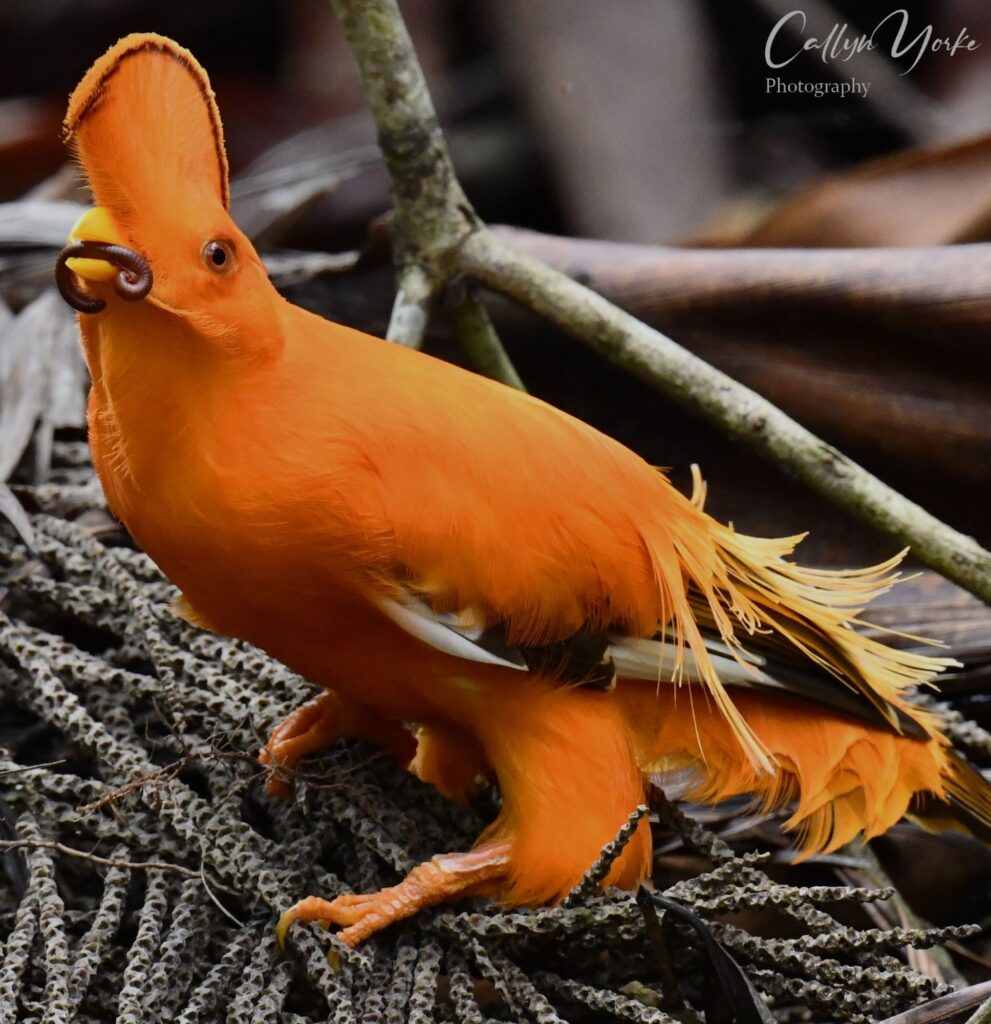
Among the highlights at Mari-Mari was the famous Giuanan Cock of the Rock. The celebrity Cotinga was suprisingly easy to find. In fact, the first morning at breakfast, a non-birder guest rushed over to my table and excitedly pointed toward the fruit orchard next to the dining area. Incredibly, a plain brown female and two fire-orange males were hopping between tree limbs. The preoccupied birds tolerated an advancing gaggle of photographers with cell phones. Later, a short walk into the adjacent forest produced a dozen more of these glitzy birds at close range. Plastic chairs had been placed outside a roped-off lekking area. Immature and adult males, each spaced a few meters apart, occupied multiple tree limb perches like three-dimensional chess pieces. The birds appeared unmoved by my presence. Since this was one of the most sought after birds in Brazil, finding it so effortlessly – and so soon – was both encouraging and somewhat anticlimactic.
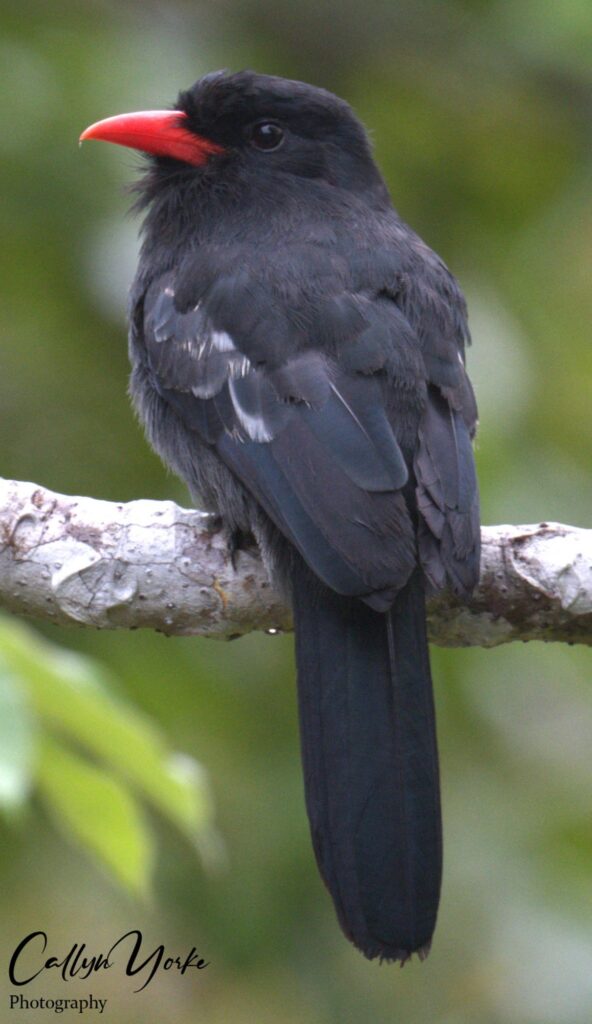
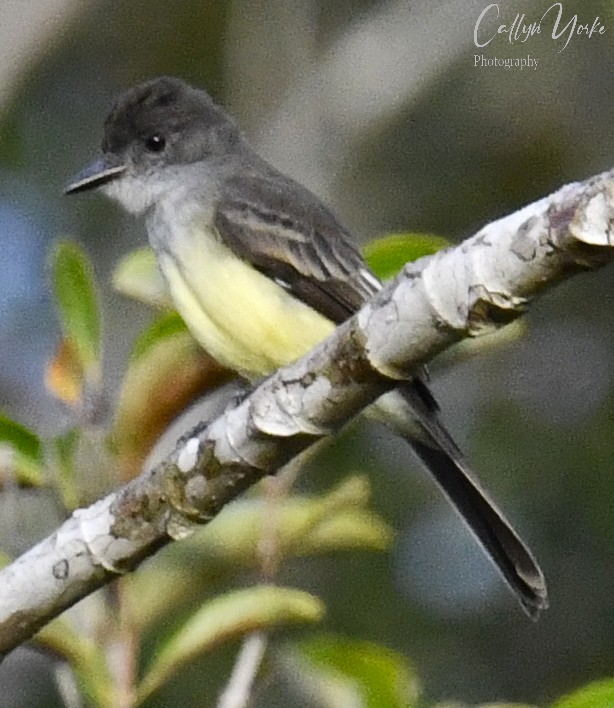
With Cock of the Rock checked off the target bird list, I turned my attention to the remarkable variety of birds found each morning in the garden trees around the lodge. Among the regulars, was a pair of Black Nunbird, catching moths and other insects under the floodlights on a cabin wall and from the bare ground and short grass nearby. The birds began snatching the live food items at dawn, sallying out from utility wires and low tree limbs. The nunbird pair appeared unruffled when I followed closely to obtain favorable photo angles and lighting. Short-crested Flycatcher, Rusty-margined Flycatcher and Piratic Flycatcher, were taking their daily breakfast in a similar manner, though decidedly less approachable for photos.
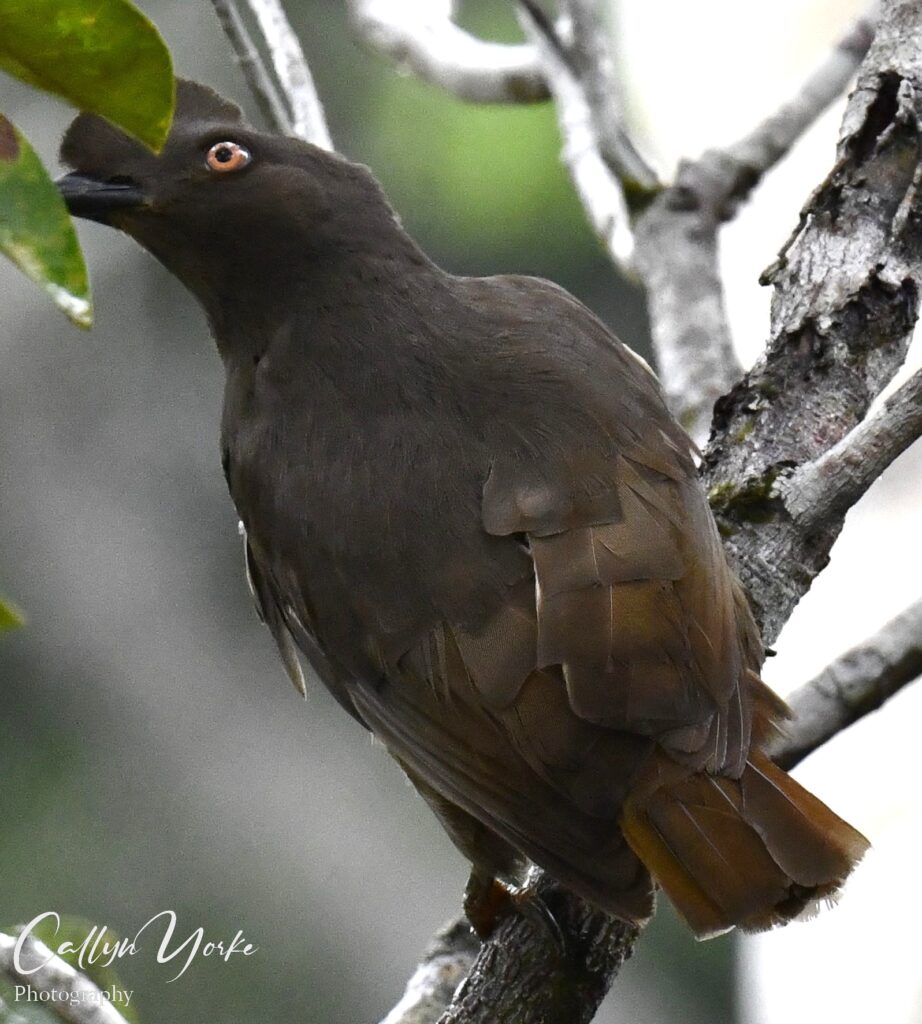
Another Cotinga A-lister, the bizarre, vulture-headed, Capuchinbird (Perissocephalus tricolor), would not be so easily found. Berg, one of the lodge workers, led me on a trek through the forest to see this bird. Somewhere in the distance a Capuchinbird was broadcasting a weird, far-carrying, moaning sound, like someone desperate to be rescued from a plane wreck. We eventually homed in on it. When we spotted the bird high in a tree top, it had evidently already seen us and was on the move. We had only a brief glimpse of it bolting through the canopy. I was clumsy with the camera and missed a chance to obtain an image of the elusive bird. Subsequent searches during the week failed to locate it. Nonetheless, I did hear the Capuchinbird repeatedly and had made positive visual contact; it was marginally countable as a lifer – WBL (want a better look). Berg mentioned that I might find other Cotinga species at Mari-Mari. He was definitely right about that. Mari-Mari was ground-zero for Cotingas.
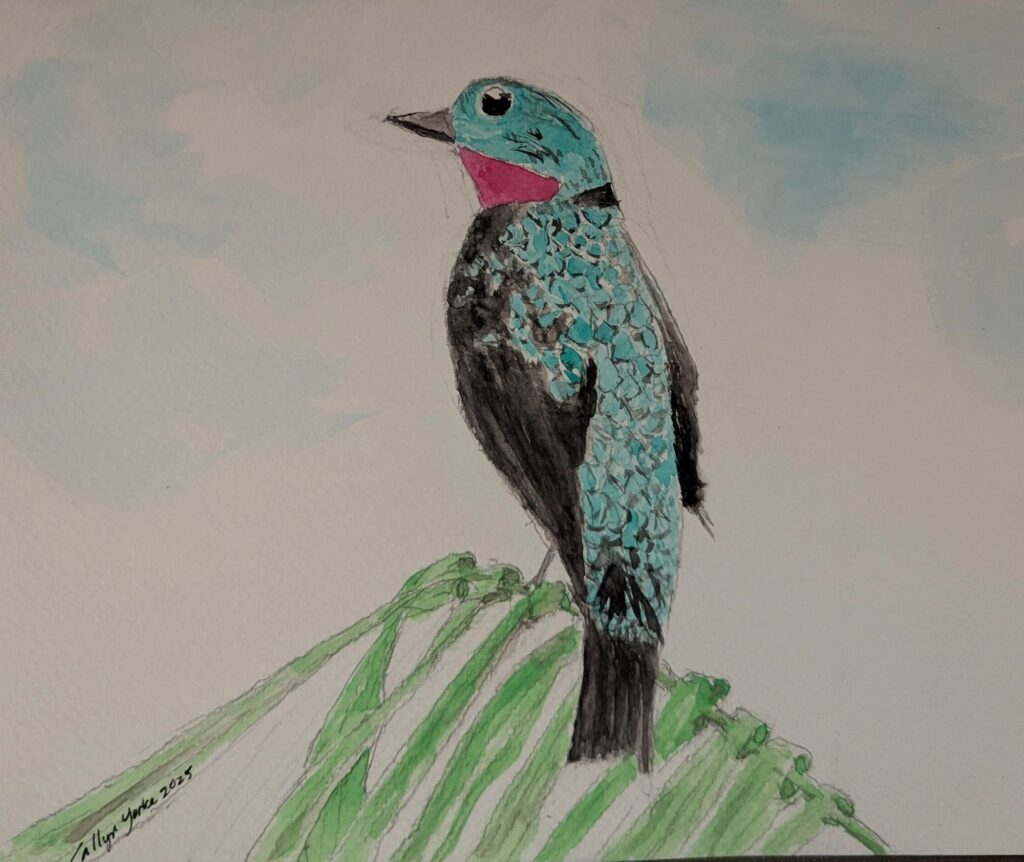
One afternoon, during intermittent light rains, I relaxed for a couple of hours in the rocking chair outside my room. An unfamiliar bird was perched atop a distant palm. Putting the binocular on it, I was delighted to see it was another stunning species of Cotinga – this one modeling a verditer-and-black-plumb-accented outfit. I captured a few identifiable images of it with the camera and compared those with illustrations in Van Perlo. There was clearly a good match – Spangled Cotinga. While still vivid in my memory and with my digital camera images for reference, I made a field sketch and painting of this unforgettable life bird.
I preferred to start the day birding as early as possible, due to unpredictable mid-morning and afternoon rains. Each morning before breakfast, I ventured further afield in search of new birds and other wildlife. During one of my dawn walks on the forest road outside the lodge, a rifle shot rang out. I paused and scanned the road for any sign of movement. Nothing. Cautiously, I proceeded down the road toward the gate of an adjacent ranch. No further shots were heard and it seemed safe to continue the morning survey. This was another sort of wildlife to be mindful of in Brazil.
Firearms had been outlawed in Brazil many years earlier, yet unregulated hunting was common in rural areas. Ranches and homesteads were spaced about every 500 m along the access road to Mari-Mari. Presumably, locals shot birds and mammals on their property. That would help explain why many of the birds and other animals around Mari-Mari were quick to seek cover when I appeared.
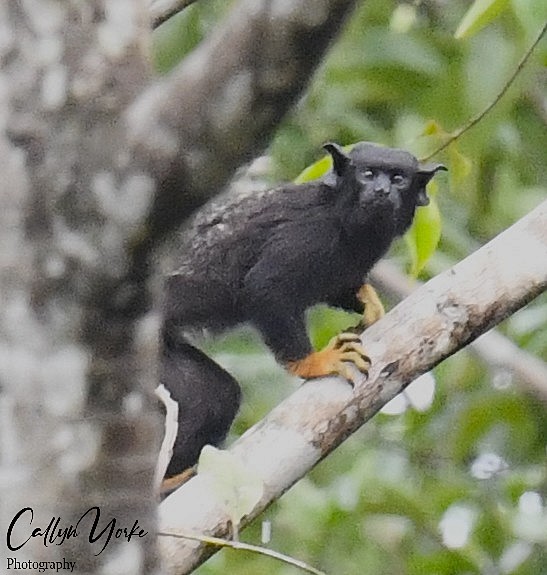
Wildlife photo opportunities were generally scarce and when I did get an opportunity, e.g. with a fast moving troupe of Golden-handed Tamarin, it was a wildlife photography-dopamine rush. I had spotted what was probably the same troupe of primates two days earlier in the forest canopy, but they had been too fast and elusive for positive identification. This time, they seemed rather curious. Some of them hesitated and stared at me just momentarily before leaping out of sight. The outsized, clawed yellow hands and feet left no doubt as to their identity.
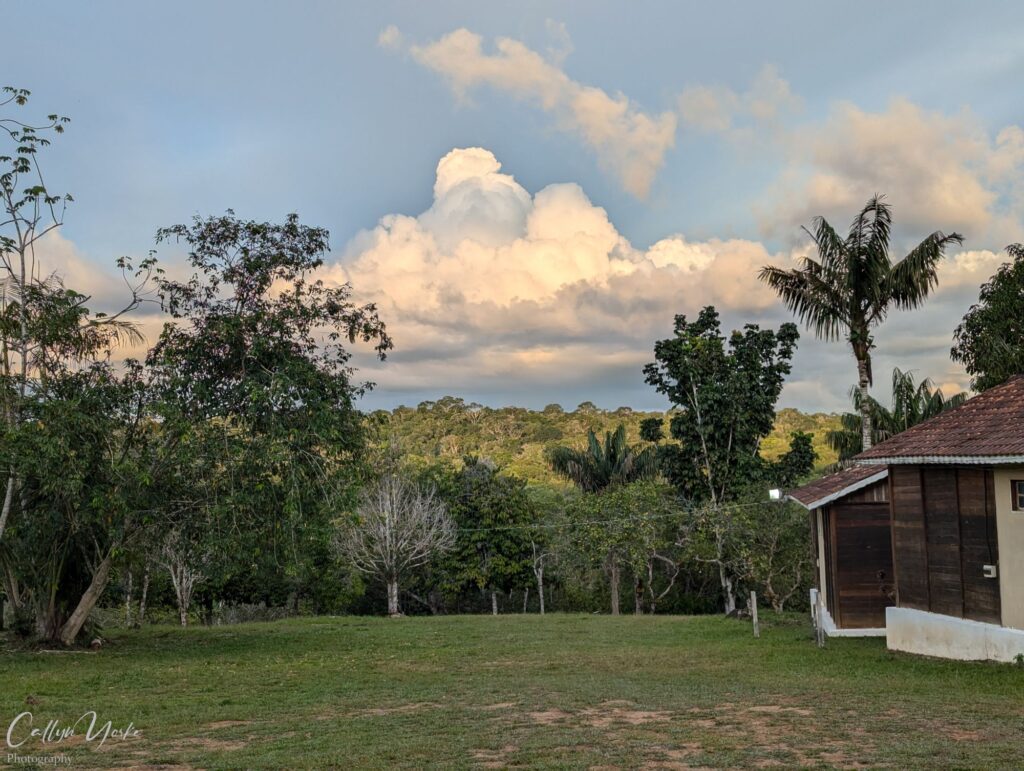
Since birding and wildlife photography opportunities were always new and interesting at Mari-Mari, I didn’t mind much that the accommodations were basic. A two-star rating would be more than fair. My cabin-style room (#10) had a small bathroom and shower with a treacherously slick tile floor. There was a comfortable bed and tiny nightstand against the wall but without a reading light or room light switch. Initially, I found two, well concealed 220v electrical outlets – one for the mini refrigerator and one above a set of floor to ceiling storage shelves. I unplugged the refrigerator and used that outlet for my laptop. The fridg was then positioned as a stepstool to reach the outlet above the shelves, which, when connected with my travel extension cord, served as a phone and camera battery charger. Subsequently, another electrical outlet was discovered behind the bed.
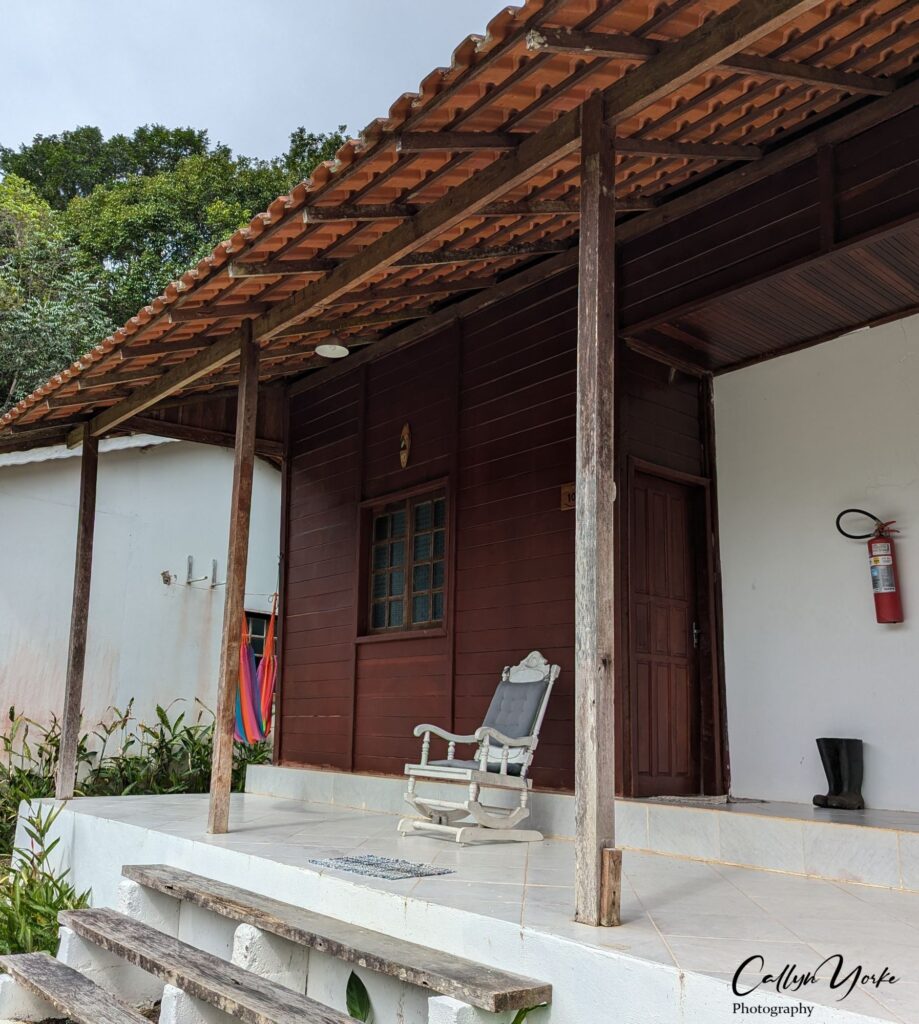
The room furniture included a narrow table and wooden chair facing a frosted-glass window. That space became my computer work station and art studio. A rocking chair was transported from a vacant cabin to the porch outside my room, which was a convenient observation deck during rains and the ideal spot for a siesta.
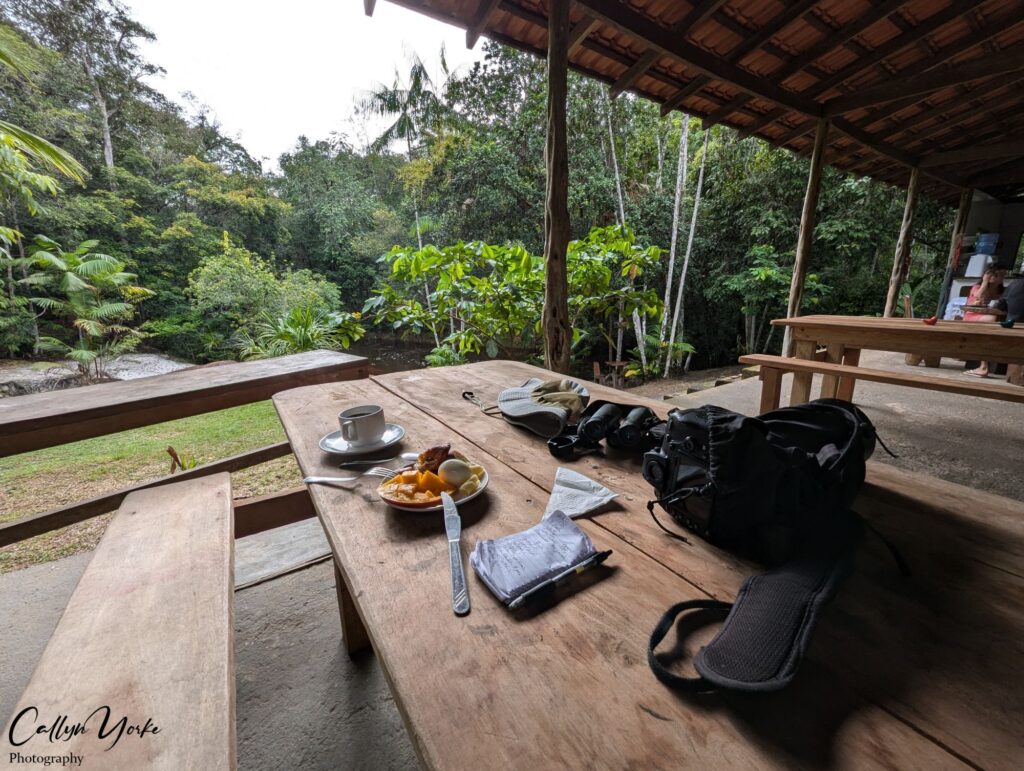
The Mari-Mari staff was extremely courteous and helpful. The kitchen was well stocked and the menu, while understandably limited, featured home-style cooking and plenty of fresh fruit and veggies. Giselle, the cook, and also Berg’s mother, specialized in native recipes — her tapioca enchiladas were incredibly delicious. Victoria handled lodge accounting and transit arrangements between Manaus and Mari-Mari; both of my two-hour journeys by taxi proceeded on schedule and without mishap. Overall, my stay at Mari-Mari was pleasant and a wonderful field introduction to the natural history of Amazonas, Brazil.
MUSA – The Natural History Museum, Forest Reserve and Botanical Gardens of Manaus, Brazil (March 13 & 14, 2025)
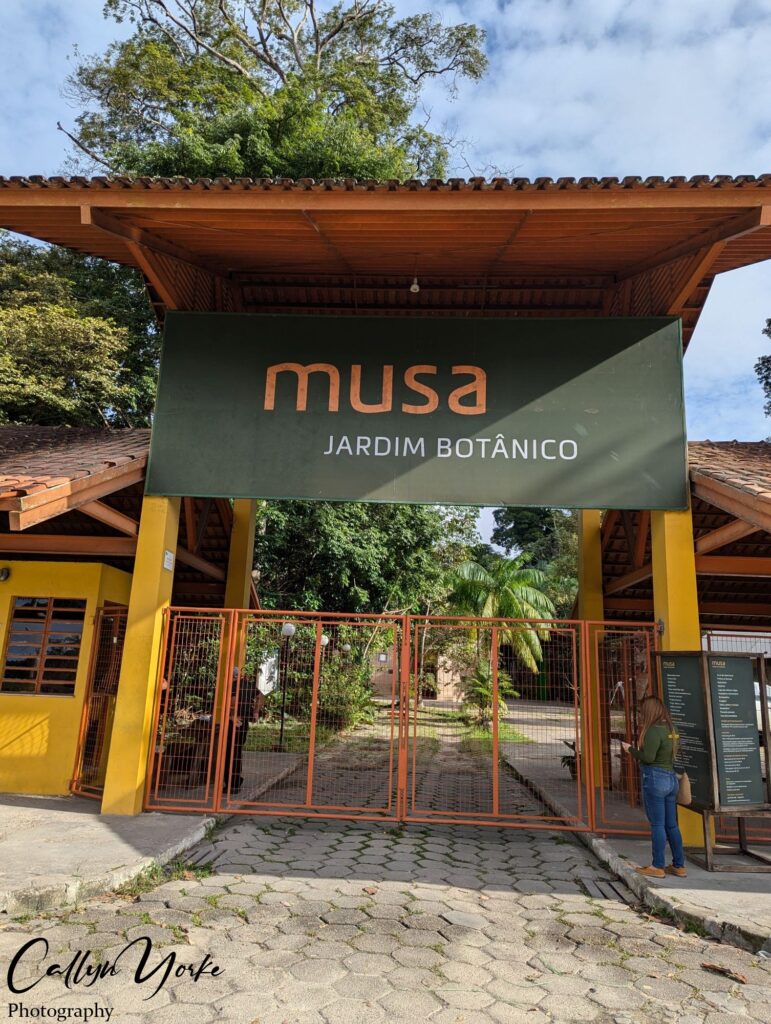
I made two visits to MUSA, the first on March 13 (0800 -1300 hrs.), when returning from Mari-Mari, and again the following morning (0500 – 0830 hrs.). My initial visit was facilitated by Victoria, who had instructed the taxi driver to first drop off my bags at the Ibis Airport Hotel, then take me to MUSA and pick me up later at the entrance. We negotiated a fair price for the extra distance and down time. Everything went as planned. We arrived at MUSA a few minutes before the gates opened at 0810 hrs..
While at MUSA the first day, I purchased a ticket ($US 10) for the weekly “bird walk” that was scheduled for a predawn rendezvous at the entrance gate the following day. What I didn’t realize at the time, was that the bird walk the next morning would be a solo event, initially with me on a forest trail in the dark. The local weather had an additional surprise in store for me.
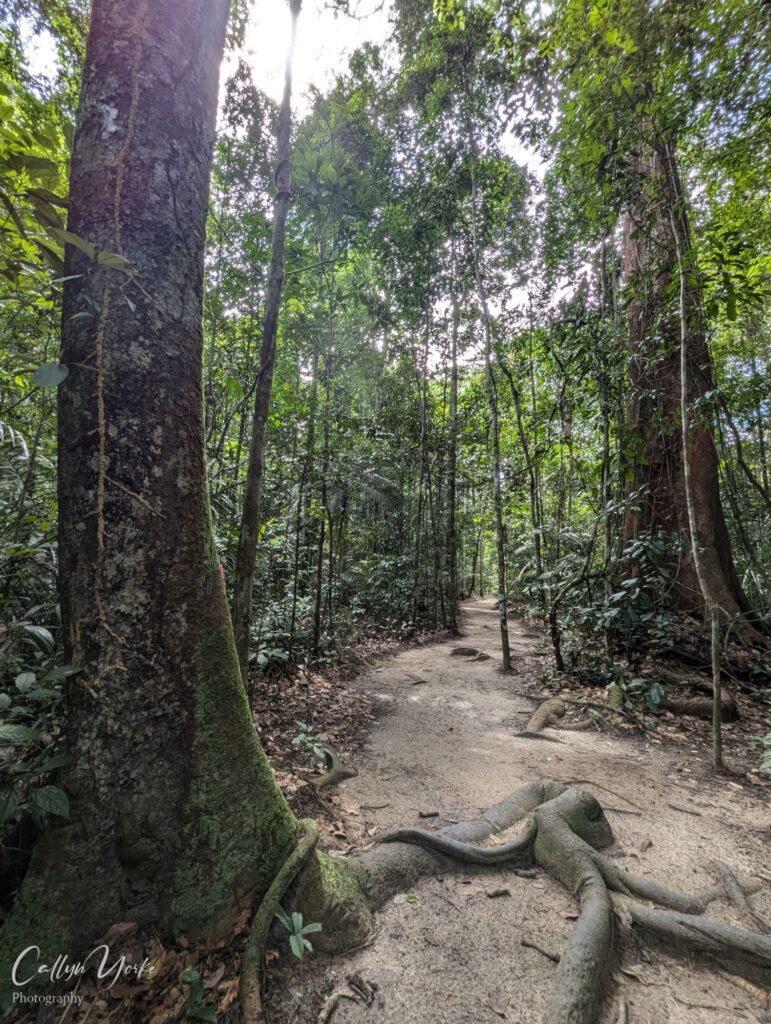
When I arrived by taxi at 0515 hrs.on March 14, a MUSA guard with a flashlight opened the side gate, wrist-banded me and motioned for me to sign in. I was expecting a MUSA naturalist or bird guide and perhaps a couple of other birders would be joining me. Nope. Instead, the guard, waving his flashlight, mumbled something in Portuguese and pointed to the trailhead behind the restrooms. When I objected (in Español) to being misinformed (actually, uninformed) regarding the details of the event, and that I did not have a proper flashlight, he reluctantly led me to the trailhead where, on pitch black forest trail, there was a slim chance I might find the canopy tower around daybreak. A reassuring sign indicated the tower was 800 m from where we stood. Evidently, the guard had fulfilled his ‘special event’ duties and from that point onward, I was entirely on my own.
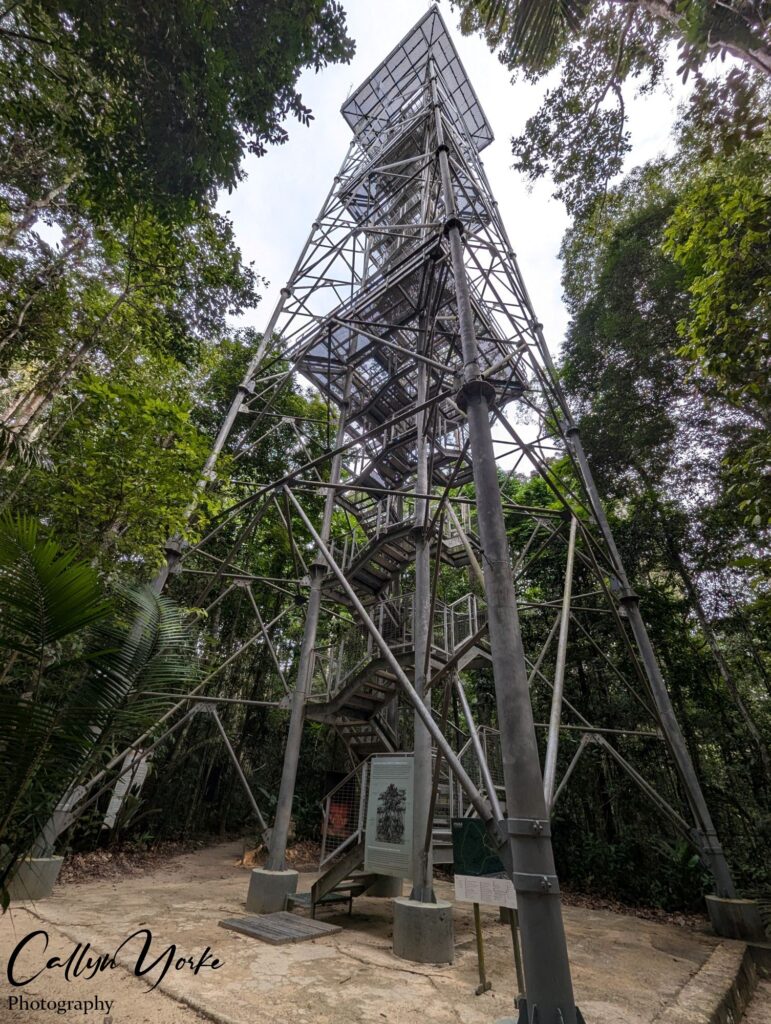
I had been on the canopy tower trail the previous day but that hike was in full daylight. Presently, I was equipped with a cell phone, a clever little illumination device that, with a head strap, might be more useful for emergency gall bladder surgery than for navigating the jungle at night. I could only guess which direction to take at unmarked trail junctions. Stumbling over tree roots and completely disoriented for about fifteen minutes, I somehow ended up at the base of the tower. The lower levels of the structure were visible in a dim, predawn haze – a cheese-grater steel staircase and pipe railing, slick with condensation. When I reached the top tier, 42 m above ground level, I rested on a wet metal bench, grateful to have arrived safely and in time for a breathtaking, 360° sunrise view over the forest.
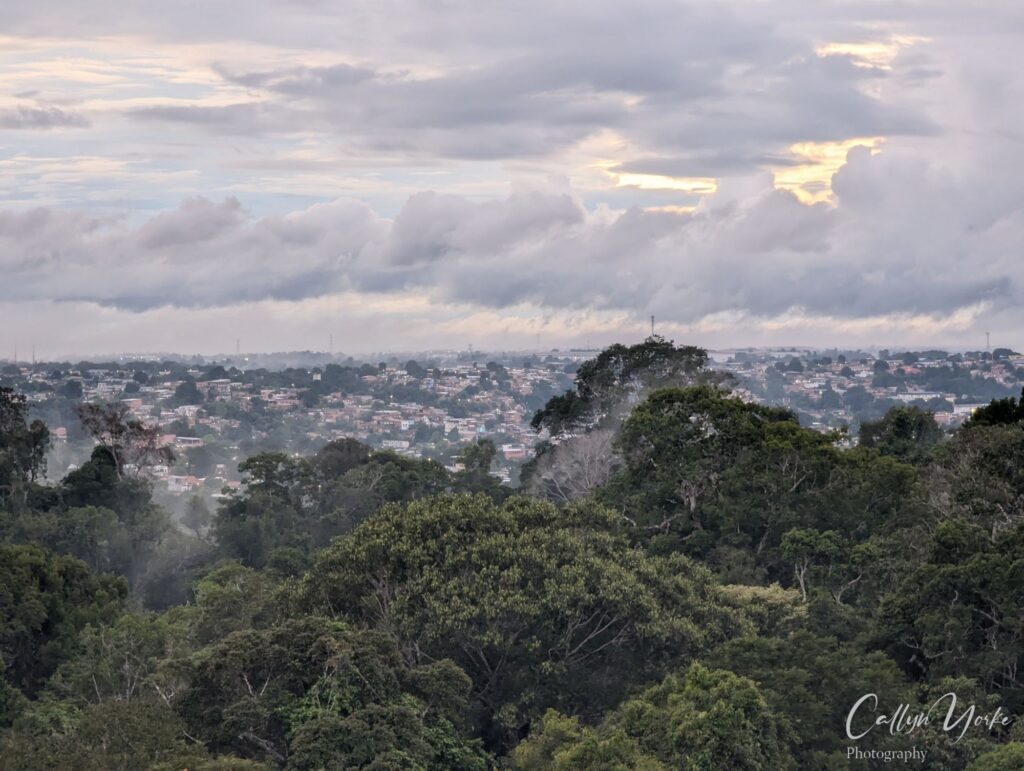
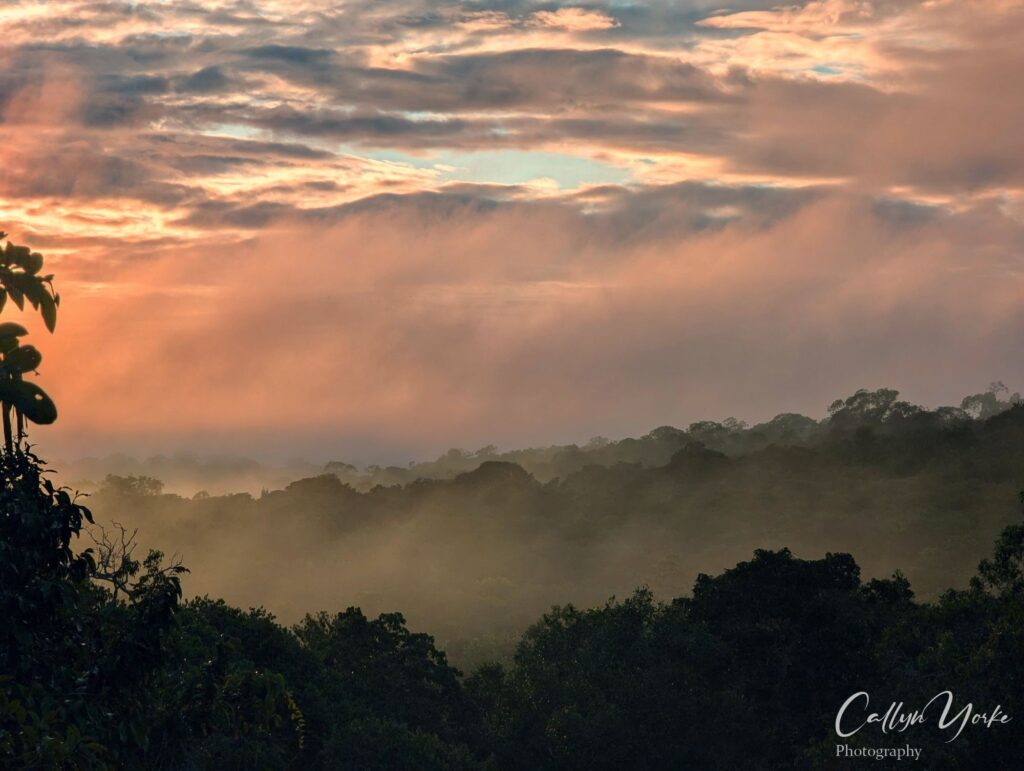
The scenery was splendid though very little wildlife was evident. The expansive forest canopy occasionally released a chirp or squawk. Mostly there was meditative silence. As the morning progressed, photography became possible, though with few subjects. A pair of distant parrots flew rapidly over the forest. A fleet of dark-bellied cumulus drifted in from the northeast. A few raindrops fell and a flash of lightning signaled that it was time to get down from what appeared to be a precocial child’s diabolical erector set – a giant galvanized lightning rod, fastened to a 300-million volt capacitor.
Hurriedly stuffing my camera gear into a shoulder pack, I had overstayed my welcome by a few critical seconds. That realization occurred as I descended the dizzying, segmented-spiral staircase, desperately hoping to find shelter somewhere in the forest. A torrential downpour had begun before I was half way to the bottom of the tower. The perforated steel construction provided absolutely no shielding from the rain. Reaching the forest floor, I sloshed and slid down the trail heading toward a carport-style shelter with a wooden table. There I stood for about fifty-five minutes, holding an umbrella under a leaky roof. Swarms of mosquitoes anticipated their breakfast. A few of them got lucky and found repellent-free patches of skin on my wrists and hands.
When the rain subsided, the trail back to the visitor center was swamped and my footwear pretty much reduced to shoe-laced sponges with neoprene soles. The park had not officially opened but the coffee shop was warming up with a few workers. I took a seat, and determined that my camera was still functioning. I contemplated the results of the ‘MUSA morning bird walk.’ Two bird species were positively identified by distant images – Red-lored Amazon and Scarlet Macaw – both pairs observed briefly in flight from the tower. Subsequently, walking around the MUSA visitor’s center, I found two more birds for my trip list – Mealy Parrot and Crested Oropendola. Otherwise, the two combined visits to MUSA contributed mostly common, widespread bird species that I had encountered elsewhere in Brazil.
ANNOTATED BIRD LIST – Amazonas, Brazil
________________________________________________________
REPORT LINKS
_________________________________