Núi Thành, Quảng Ngãi
Núi Thành, Quảng Ngãi 17-18 June 2025 Callyn Yorke
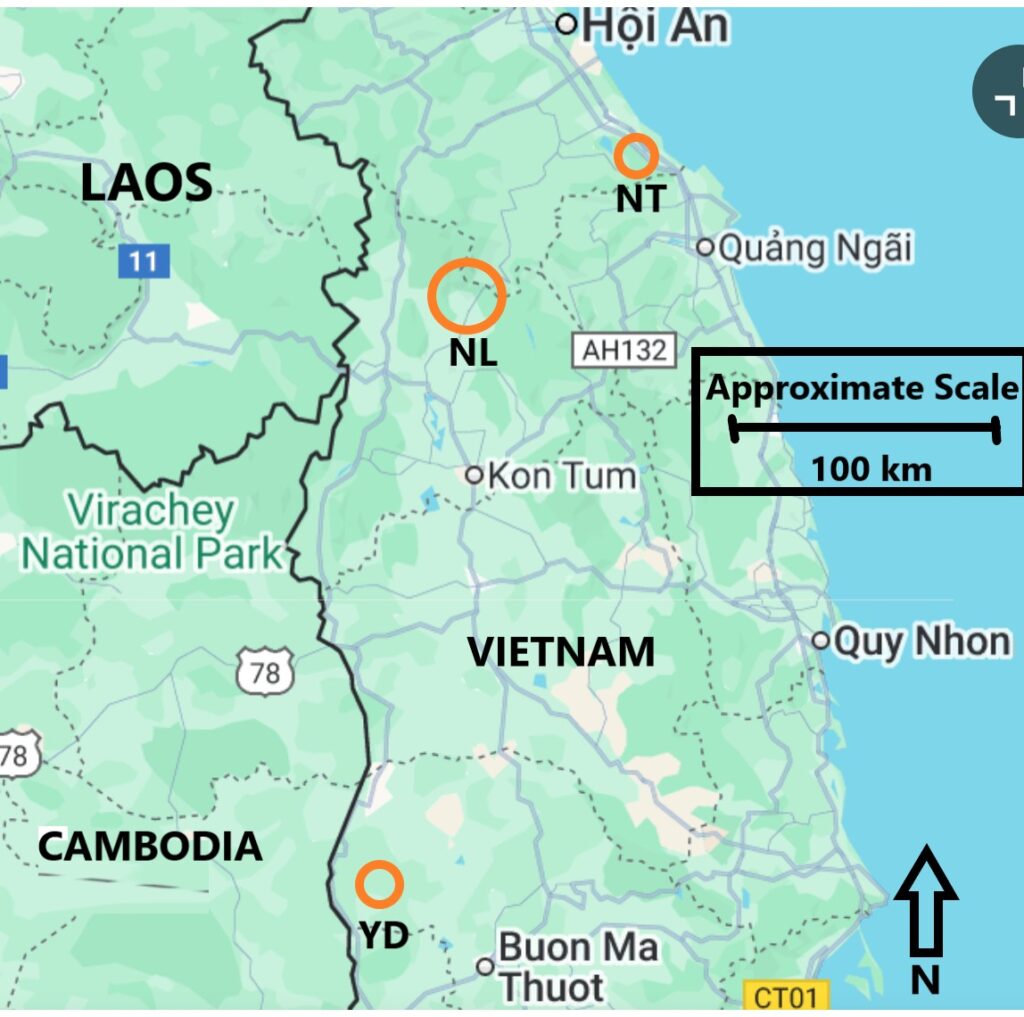
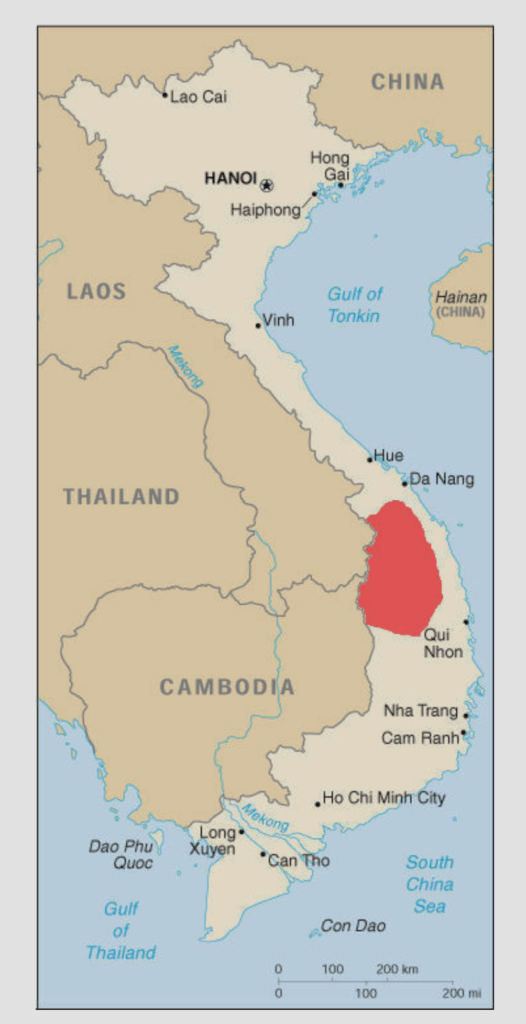
Lê Quý Minh and I were at the third and final destination of our Việt Nam road trip. We had begun the journey on June 10, 2025 in Yok Đôn National Park, Đắk Lắk. Birds were the primary objective. Our attention now shifted to one of Việt Nam‘s rarest endemic animals, the Gray-shanked Duoc Langur. This forest-loving primate, listed as Critically Endangered, presented us with an extraordinary opportunity to observe how they are getting along in what remains of their natural habitat.
We arrived in Núi Thành on the afternoon of June 17, without lodging reservations. The drive from Tu Mơ Rông, Kon Tum Province, including a few birding stops, had taken us about seven hours. We were tired, hungry and temporarily disoriented.
Núi Thành city expanded in recent years and had become largely dependent on the motor vehicle industry. Our introductory tour of the vast Núi Thành auto-industrial complex, came as a result of missing a highway on-ramp. We drove by a series of modern assembly plants, e.g. Vinfast (A Vietnamese auto maker) and several Japanese auto and truck makers. A maze of unsigned driveways and boulevards, nearly had us going in circles.
When we finally found the correct road leading to the main street in town, it was mid-afternoon and well past lunchtime. It soon became evident that most of the working residents of Núi Thành dined elsewhere. Coffee shops were plentiful but restaurants were scarce. We settled at a street corner cafe with one rather salty item on the menu – chicken noodle soup (Miến Gà). I washed it down with a warm can of Fanta soda.
With the courage of a full stomach and the car AC on high, we continued the search for lodging. Online information, combined with Google Maps, brought us to a new hotel on a quiet backstreet. The modern, multilevel, Thành Vinh Hotel, was upscale lodging, compared with the places where we had been staying the past week. They offered us a substantial, promotional discount. Best of all, nearby were paddy-fields, fish ponds, wetlands and backroads – perfect for drive-by birding at sunset and first thing the following morning.
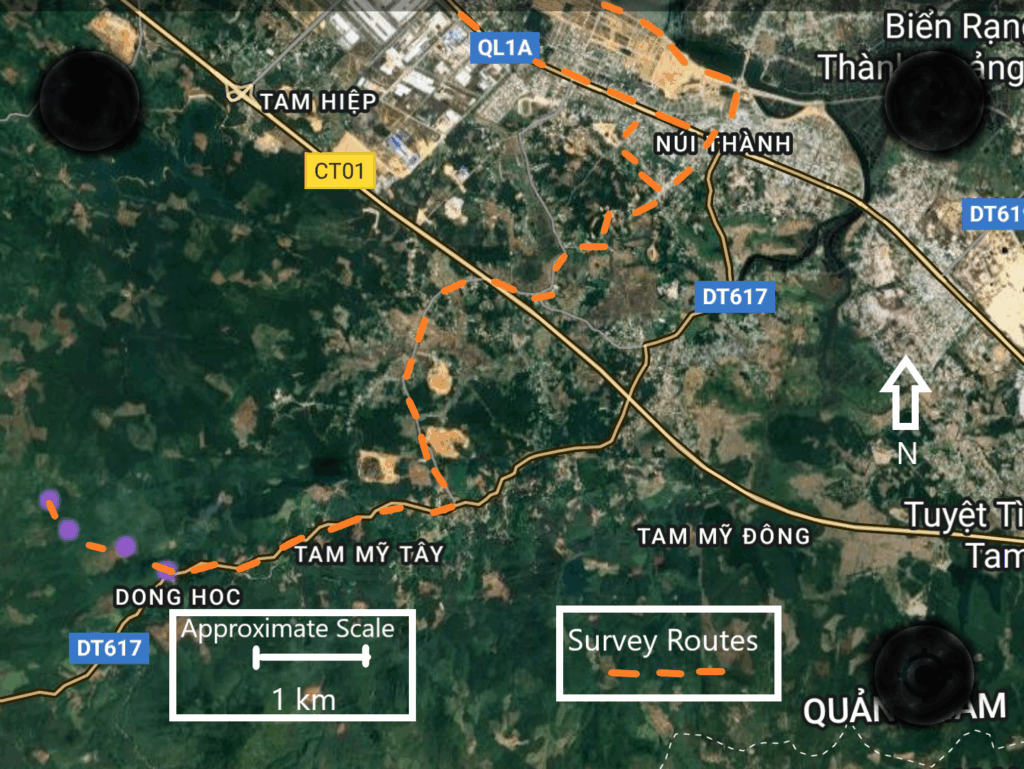
For an early start the next day, June 18, 2025, we skipped breakfast (we couldn’t find food service in town) and headed for the Gray-shanked Douc Langur site, staying on village backroads. We stopped a few times for bird sightings. Taken together, our brief afternoon and morning surveys of Núi Thành, produced sixteen new bird species for our trip list, including, Slaty-breasted Rail, Little Tern, Black-crowned Night-heron, Striated Heron and Eastern Cattle Egret. We agreed that a return visit to Núi Thành during the winter months should be quite productive for birding (see ANNOTATED BIRD LIST).
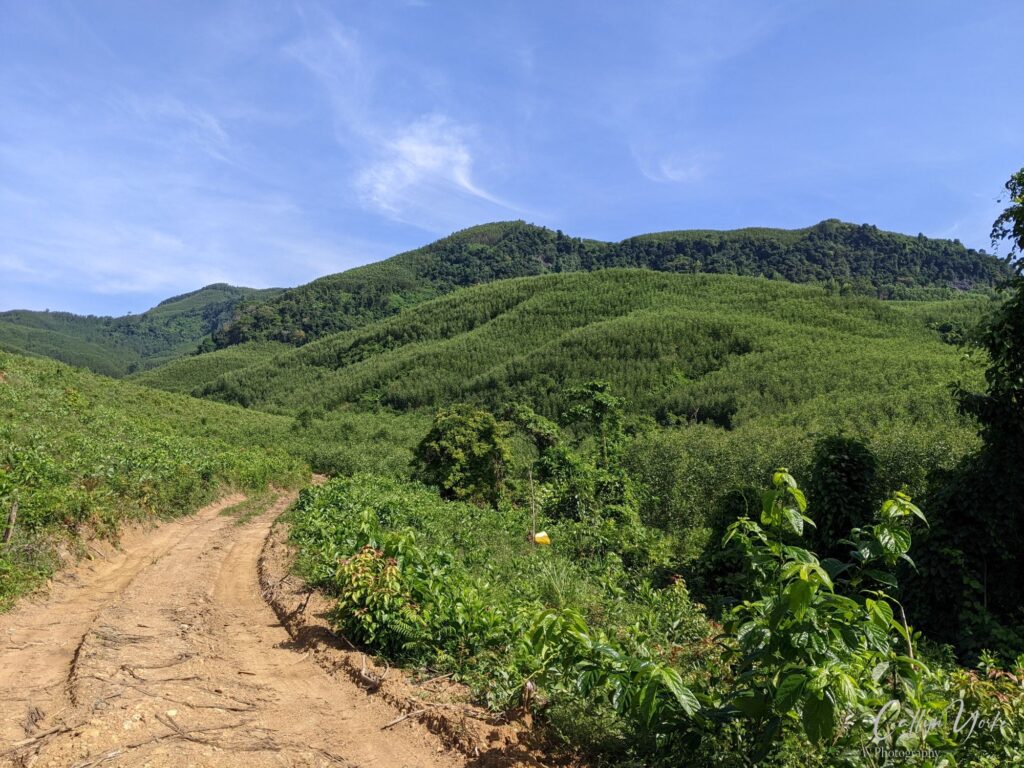
Núi Thành rural roads dissected a landscape dominated by Acacia plantation, rice paddy-fields and plots of active and fallow farmland. There was absolutely no natural forest habitat anywhere to be found. I wondered if the Gray-shanked Duoc – a deforestation refugee – was being kept in some sort of semi-natural enclosure for its own good. That horrifying image turned out to be not far from the truth.
Minh was on the phone with the person who would be taking us to see the Gray-shanked Duoc. We suddently veered off a paved road and bounded into a Acacia plantation. A short, stocky, very serious looking man, was standing there waiting for us. His name was Dư’. He was the director of the Gray-shanked Duoc conservation program in Tam Mỹ Tây. Entry into this protected area was possible only with his approval. After a brief discussion with Minh, we were ready to proceed to the duoc langur site.
There were two options for our transport: Dư’s motorbike, or boots on the ground. Minh suggested the motorbike was the best option. The duoc langur site was about 1.5 km further, near the end of a rugged, canyon trail. I made a quick safety inspection of the motorbike. The stripped down,110 cc machine, had been through tough times – possibly including a war. Reassuringly, it retained a passenger seat and foot pegs. I gave it a passing grade and made a hasty – just go for it – decision. I imagined my son would have been proud of his old man. Minh was almost smiling. I assumed that after dropping me off at the duoc viewing site, Dư would return to fetch Minh. Instead, Minh, quite the trooper, chose to hoof it the entire way.
After the first few minutes hanging onto the back of the under-powered, unmuffled motorbike, I totally got why Minh had chosen to walk. We were being bounced and jerked around like a couple of drunks on a mechanical bull. I kept one hand on the rear seat bar and the other on a seat strap between my legs. At maximum throttle in low gear, we hit pretty much every hole and rock, killing the motor on a couple of the larger stones. The trail narrowed, turned into a streambed, then a ditch, then ascended steeply to a weedy clearing. When we reached the duoc viewing site, the vintage motorbike and I both let out an exhausted sigh of relief. The only thing missing was a cheering crowd.
Actually, there was something else missing – the Gray-shanked Duoc. A recent count had the local population at ten individuals, including a youngster. For thirty-minutes we scanned the adjacent ridge where a patch of broad-leaved forest remained. Nothing was moving. This was serious. Mostly absent here, was habitat for a critically endangered primate. Evidently, without a viable forest corridor connecting to a larger natural area, these arboreal vegetarians were confined on a hilltop island surrounded by a monoculture of inedible salad.
Minh quietly approached us, having just made the lengthy uphill trek through the plantation. His shirt was soaking wet with perspiration. He was informed that we needed a new plan. Dư pointed to a trail extension and the three of us hiked for ten-minutes uphill to a small clearing. The trail ended there. This would presumably be my last chance to see a Gray-shanked Duoc.
Dư led the way and before I could catch up with him, was motioning for me to make haste. He had seen a pair of Gray-shanked Duoc on the ground, foraging in a ravine next to the viewing area. I was too late. The couple had retreated into the Acacia plantation and was probably headed for the forested ridge, about one-hundred meters further. The three of us continued monitoring the plantation and forest for movement. Minh saw something and photographed it with his Nikon D500 and long lens. Ahh. His photo showed only a Rhesus macaque (Macaca mulatta), a common and highly adaptable species, having the widest range of any non-human primate. With the sun beating down on the forest canopy and animal activity diminishing with rising air temperatures, it seemed likely that this once-in-a-lifetime, Gray-shanked Duoc expedition, would be a disappointing dip.
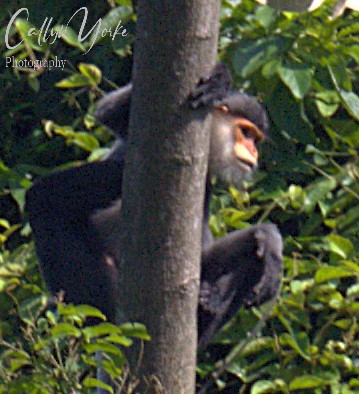
After about twenty-minutes, Minh spotted movement in a tall tree near the upper edge of the plantation. I wasn’t onto anything at first and just fired off a few photos in the direction Minh had indicated. He looked over my shoulder as I scrolled through the digital camera images. And there it was! An adult Gray-shanked Duoc, part way up the trunk of a forest tree! Wow! But judging by the rather concerned facial expression, perhaps it wasn’t feeling so lucky. Looking as though it was awaiting Noah’s ark, the creature was clinging to the last remnants of its forest home.
Considering the precarious plight of these animals, there wasn’t much cause for celebration. They were surviving. We could certainly testify to that fact. But for how much longer? Racing up to see them on a noisy motorbike probably alarmed the creatures, even if they were semi-habituated to being visited by large, curious, well intentioned hominids. Were we part of the solution or part of the problem?
Clearly, locals, like Dư, were actively involved with the lives of these defenseless primates – constantly looking for ways to increase viable habitat, establish corridors of dispersal between forested sites, and guard against poachers. But when economics and village livelihoods are at stake, habitat and wildlife conservation becomes a Sisyphean task. Saving the Gray-shanked Duoc Langur was, quite literally in this case, an uphill battle.
For good measure, I was pleased to pay Dư for his services. Minh said that most of the money ($VND 1.3 million) would be given to the primate conservation organization. The remainder was for Dư, his family and perhaps a motorbike upgrade. I was making a small contribution (about $US 50) to a hugely important endangered species recovery project. The Gray-shanked Douc could definitely use all the protection and financial backing that was available.
Dư graciously accepted the wad of cash and stuffed it in his shirt pocket. He smiled and wished us well. Taking our time, Minh and I birded the plantation trail back to the car. A few species showed up, including two new birds for our trip list, Wedge-tailed Green-pigeon and Hill Blue-flycatcher. The mid-morning air temperature was rising and we appreciated the incidental shade of the Acacia plantation.
It was a worthwhile and provocative, rare-primates-of-Việt Nam, side trip. Gray-shanked Duoc had been on my bucket list for several years, since an unforgettable experience of photographing its glamorous cousin, the Red-shanked Duoc. Thanks to habitat conservation efforts by the Vietnamese government, that species is doing comparatively well on Sơn Trà Mountain in Đà Nẵng. Sustaining the upbeat tune here, we might expect that, as ecotourism infrastructure in Việt Nam continues to improve, so will the chances of survival for these and other vulnerable primates.
Now that our Việt Nam road trip was approaching the finish line, Minh would be driving me back to Đà Nẵng, then continuing to his home in Huế. Lê Quý Minh and I had completed another memorable field trip together and I was very much looking forward to our next one, wherever that might be.
________________________________________________________
ANNOTATED BIRD LIST – Núi Thành, Quảng Ngãi 17-18 June 2025 Callyn Yorke
KEY TO ANNOTATIONS
Observer noted when only one of us encountered the bird: Lê Quý Minh (LQM); Callyn Yorke (CY)
Location Abbreviations: NT = Núi Thành area, including city, village, wetlands, paddy-fields, aquaculture ponds, farmland, active and fallow; TMT = Tam Mỹ Tây area, including, Gray-shanked Duoc forest patches, Acacia plantation, second-growth and farmland.
Bird Behavior: greg. = gregarious; msf = mixed species flock; agl = estimated height above ground level (m); voc. = vocalizations, i.e. calls and/or song; HO = heard only.
Numerical abundance, frequency and distribution: Highest number of individuals found and counted at the first indicated location in a sequence. ubiq. = ubiquitous in the appropriate habitat(s).
Systematics and Taxonomy is an amalgam of the most recent (2025) online lists by Birdlife International, AVIBASE and International Ornithological Congress (IOC).
BIRDS
PIGEONS AND DOVES Columbidae
- Feral Rock Pigeon Columba livia 20 greg., mostly in towns and villages, ubiq.
- Eastern Spotted Dove Spilopelia chinensis 4 greg. NT.
- Zebra Dove Geopelia striata 1 on roadside, NT.
- Wedge-tailed Green Pigeon Treron sphenurus 2 (LQM) greg. TMT
SWIFTS Apodidae
- Germain’s Swiftlet Aerodramus germani 30 greg. ubiq.
CUCKOOS Cuculidae
- Greater Coucal Centropus sinensis 3 voc. (unseen) second-growth, ubiq..
- Plaintive Cuckoo Cacomantis merulinus 3 voc.(unseen) and in flight over village, NT.
- Indian Cuckoo Cuculus micropterus 3 voc. (unseen) second-growth surrounding paddy-fields and farms, NT.
RAILS, GALLINULES AND COOTS Rallidae
- Slaty-breasted Rail Lewina striata 2 walking at edge of paddy-field; one in drainage ditch, NT.
HERONS Ardeidae
- Black-crowned Night-heron Nycticorax nycticorax 1 flying low over an aquaculture pond, NT.
- Striated Heron Butorides striata 1 (LQM) in flight over an aquaculture pond, NT.
- Eastern Cattle Egret Bubulcus coromandus 1 in a flooded paddy-field, NT.
- Little Egret Egretta garzetta 3 in paddy-fields, NT.
CORMORANTS Phalacrocoracidae
- Little Cormorant Microcarbo niger 50+ greg. a large flock flying 50m agl over wetlands, NT.
GULLS, TERNS AND SKIMMERS Laridae
- Little Tern Sternula albifrons 5 loosely greg. swooping low over fish ponds, NT.
BEE-EATERS Meropidae
- Blue-tailed Bee-eater Merops philippinus 2 individuals in flight over roadway and paddy-field, NT; TMT
KINGFISHERS Alcedinidae
- White-breasted Kingfisher Halcyon smyrnensis 3 voc. (unseen) second-growth around paddy-fields and ponds, NT.
DRONGOS Dicruridae
- Black Drongo Dicrurus macrocercus 2 (CY) greg. a pair flying low over hilltop forest, TMT.
- Sooty Drongo Dicrurus leucophaeus 3 greg. in subcanopy of Acacia plantation, TMT.
- Greater Racquet-tailed Drongo Dicrurus paradiseus 5 greg. voc., including imitations of an Eastern Jungle Crow, Acacia Plantation, TMT.
MONARCH FLYCATCHERS Monarchidae
- Black-naped Monarch Hypothymis azurea 2 (LQM) voc. in Acacia plantation, TMT.
SHRIKES Laniidae
- Chinese Long-tailed Shrike Lanius Schach 1 on utility wire next to open field, NT.
CISTICOLAS AND ALLIES Cisticolidae
- Double-zitting Cisticola Cisticola tinnabulans 5 voc. perched at edge of paddy-fields in tall grass; low, short flights, NT.
- Yellow-bellied Prinia Prinia flaviventris 4 voc. grassy edges of paddy-fields, NT.
- Dark-necked Tailorbird Orthotomus atrogularis 3 voc. second-growth margins of Acacia plantation, TMT.
BULBULS Pycnonotidae
- Black-crested Bulbul Pycnonotus flaviventris 2 voc. Acacia plantation, TMT.
- Southern Sooty-headed Bulbul Pycnonotus aurigaster 4 voc. second-growth and gardens, NT.
GROUND BABBLERS Pellorneidae
- Buff-breasted Babbler Trichastoma tickelli 1 voc. (LQM) dense second-growth, TMT.
STARLINGS Sturnidae
- Black-collared Starling Gracupica nigricollis 2 in flight over forested hilltop, TMT.
- Common Myna Acridotheres tristis 12 greg. pairs on ground and in low flight, ubiq..
OLD WORLD FLYCATCHERS AND CHATS Muscicapidae
- Oriental Magpie-robin Copsychus saularis 2 voc. understory of Acacia plantation, TMT.
- Indochinese Blue-flycatcher Cyornis sumatrensis 4 (m,f) voc. greg. pairs sally-flycatching in subcanopy and mid-level of Acacia plantation, TMT.
SUNBIRDS Nectariniidae
- Ornate Sunbird Cinnyris ornatus 2 voc. in village gardens, NT.
- Greater Crimson Sunbird Aethopyga seheriae 1 (LQM) TMT.
OLD WORLD SPARROWS Passeridae
- Eurasian Tree Sparrow Passer montanus 50 + in towns and villages, ubiq..
- Indian Sparrow Passer indicus 2 (LQM) in a town parking lot next to a cafe, NT.
___________________________________________________________
LINKS TO REPORTS
Yok Đôn National Park, 10-15 June 2025
____________________________________________________________